
Reviewed · OSAKA SAMURAI & NINJA EXPERIENCES
Learning Shodo with a kimono and Trying Samurai Calligraphy
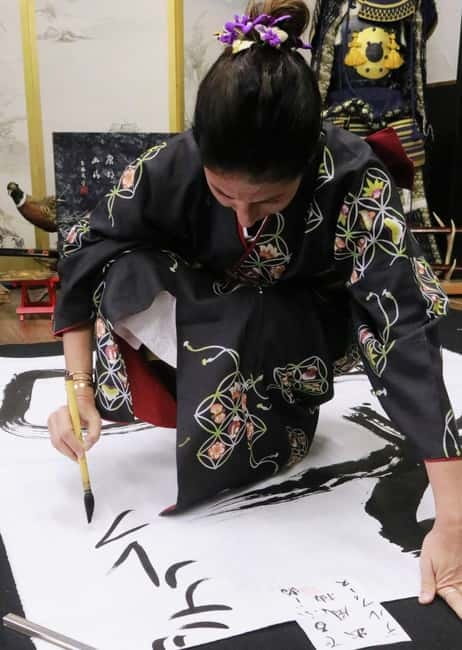
The most memorable part of this Osaka activity is the change from quiet brush practice to a giant-brush samurai performance. You choose a kanji character, learn its meaning and stroke order, then create a bold final piece on large paper while dressed in a kimono or samurai costume.
I like the friendly, family-ready format, and I like that you leave with more than photos: your calligraphy, a kanji version of your name, and an original Samurai Honor bag. The main caution is the timing. The program describes 60 minutes of shodo plus a 30-minute samurai section, while the advertised duration is one hour, so confirm the exact schedule before booking.
In This Review
- Key points to know before booking
- Changing into a kimono before touching the brush
- Holding the brush and learning the basics of shodo
- Choosing kanji and discovering what your name means
- The oversized brush and your one-character statement
- Photos, hairstyle options, and the souvenir bag
- Is $42 a fair price?
- The one-hour question you should settle first
- Who will enjoy this most?
- Should you book Samurai Honor calligraphy?
- FAQ
- Where does the calligraphy experience take place?
- How early should I arrive?
- Is the activity suitable for children?
- What languages are available?
- What is included in the price?
- Are hair styling and hanging scrolls included?
- Can I cancel the booking?
Key points to know before booking
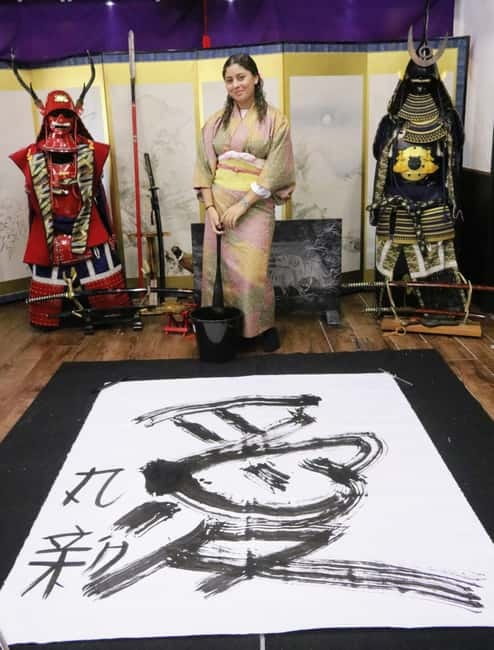
- Kimono and costume photography: Change into traditional clothing before you pick up the brush, with photo data sent to your designated email address.
- Meaning behind your name: A calligraphy master writes your foreign name in selected kanji and explains the meaning of the characters.
- Large-brush finale: You create one powerful character on a 150-by-150-centimeter sheet using a brush more than five times larger than normal.
- Good for families: Children from age five can join, and the activity is designed for shared practice rather than silent observation.
- Small group setting: The group is limited to 10 people, with English as the default interpretation language.
- Watch the extras: Japanese hair styling, hairpins, outdoor photos, and calligraphy on a hanging scroll are optional paid additions.
Changing into a kimono before touching the brush
This experience begins with preparation, not calligraphy. You arrive at Bushi no Homare, also called Samurai Honor, and change into a kimono or samurai costume before starting the lesson. Bring a T-shirt, which is the only specific clothing request provided for the activity.
I like this order. Calligraphy in Japan is not only about writing a word correctly. The clothing, posture, brush, ink, paper, and empty space around the character all affect the finished piece. Putting on traditional clothing first helps you treat the lesson as a cultural activity rather than a quick souvenir workshop.
The venue is at Excellence Takayama 1F, 2-3-19 Shiginonishi, Joto-ku, Osaka. Use Google Maps rather than Apple Maps, since the Apple Maps address is reported as incorrect. Look for the wooden Samurai Honor sign, the rack of activity pamphlets, and kimonos or hakama hanging outside.
Plan to arrive 30 minutes before your booked start time. That early arrival is needed for instructions and changing clothes. If you arrive at the listed start time, you may lose part of the calligraphy lesson.
The setting is practical rather than polished. A train line runs close to the venue, and one booking found the surroundings unattractive and noisy. That is worth knowing if you expect a formal studio or a quiet traditional house. The instructor, not the building, is the heart of this activity.
More samurai and ninja experiences:
- Samurai Training Experience KENDO in Osaka
★ 5.0 · 515 reviews - OSAKA NIGHT FUSION Japanese Taiko Kabuki Samurai Dance Show
★ 4.8 · 155 reviews - Osaka: Samurai Training Experience KENDO in Osaka
★ 5.0 · 111 reviews
Holding the brush and learning the basics of shodo
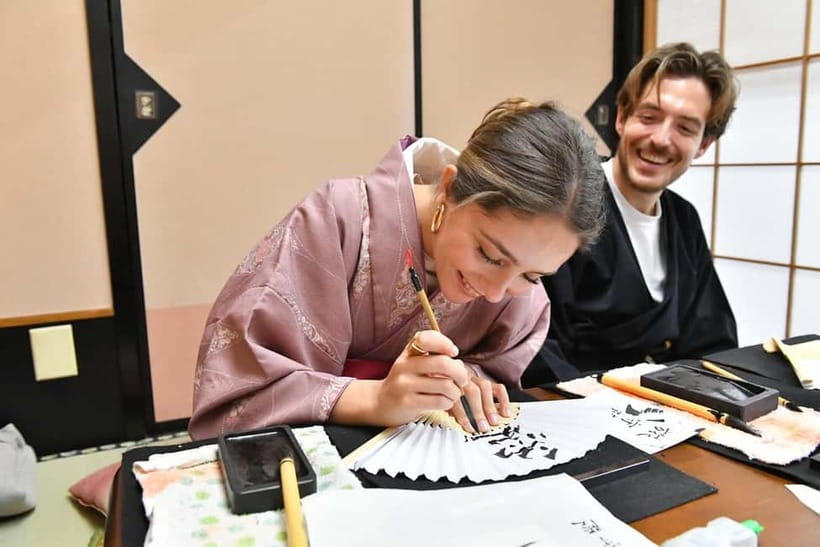
Once dressed, you begin with the mindset and tools of Japanese shodo. The instructor shows you how to hold the brush and use the equipment, then leads you through basic brush movement and pressure.
This part matters even if you have never drawn or written with a brush. A calligraphy brush does not behave like a pencil. The angle, speed, pressure, and lift at the end of each stroke change the shape of the line. You practice these movements before working on your chosen kanji.
The class is built for beginners, so you do not need to know Japanese. English interpretation is the standard option, and Japanese, Italian, French, Chinese, Thai, and Spanish may be available depending on staff. If you need a language other than English, ask before booking. Availability is limited and cannot be guaranteed.
The group size is capped at 10 people. That is small enough for a teacher to watch your brush technique, though the amount of individual attention will depend on how full the session is. A family can work together without the children feeling as if they are attending a formal adult class.
Children under five cannot join. The activity is especially suitable for children around six to eight, the age when many children in Japan begin learning calligraphy. Younger children may need help with the brush and the discipline of slow, careful strokes.
Choosing kanji and discovering what your name means
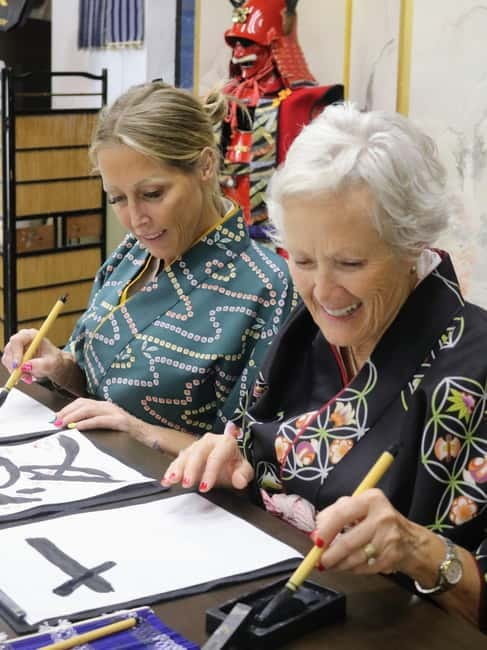
The kanji portion gives the activity more substance than simple costume photography. You choose characters, learn their meanings, and practice their correct stroke order. The master then demonstrates the writing process while you follow along.
Kanji characters carry meaning as well as sound. A foreign name cannot always be converted into Japanese in one exact way, so the selected characters have importance. The teacher writes the participants’ names in kanji and explains the meaning of the characters used.
That explanation is one of the most useful parts for you and your children. It gives the finished work a personal connection, rather than leaving you with a random Japanese symbol chosen for decoration. Ask questions about the character choices while the instructor is demonstrating them.
You practice several times before making a final draft. The aim is not perfect handwriting. It is to understand the order and rhythm of each stroke, then produce a piece that shows what you learned. Expect some uneven lines. That is part of learning with a brush.
Your final work can be made on calligraphy paper, a fan, or a hanging scroll. The hanging scroll, known as a kakejiku, costs extra. If you want a display-ready piece for your home, check the package price before arrival rather than assuming it is included.
The oversized brush and your one-character statement
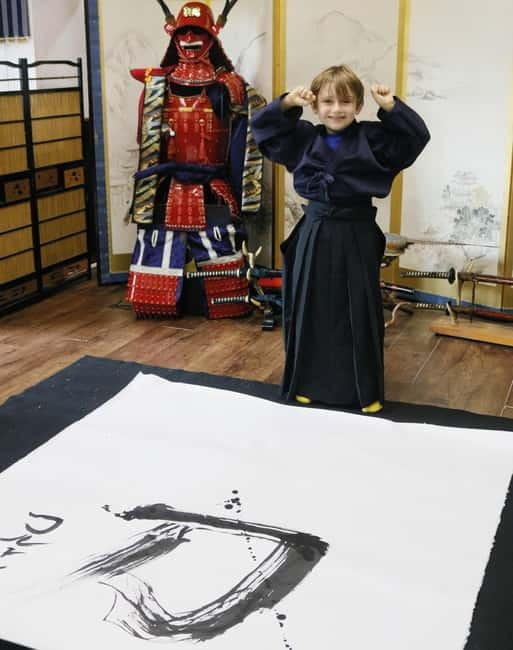
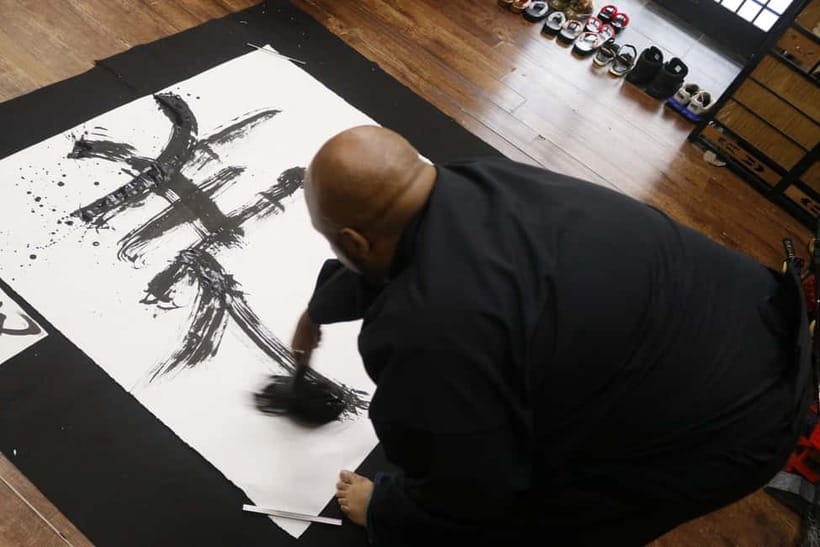
The samurai calligraphy section changes the mood. You reflect on your life so far and choose one character to represent what you want to leave behind. The wording is dramatic, but the idea is simple: choose a character with personal meaning and express it through one bold design.
You then use an oversized brush that is more than five times larger than a standard calligraphy brush. The character is created on a 150-by-150-centimeter sheet of paper. This is not a small desk exercise. The artist uses the whole body to guide the brush across the paper.
The size gives this section its visual punch. A normal brush rewards tiny adjustments. A giant brush asks you to think about movement, spacing, balance, and the empty areas around the ink. Japanese calligraphy gives blank space a role, so the character is not meant to fill every corner of the paper.
You sign the work afterward. That signature identifies the person who created the character and gives the piece a clear owner. The process is less about producing a museum-quality artwork and more about making a physical statement in a traditional form.
If you have children with you, this part may need extra patience. The character is large, and the brush may be difficult for a small child to control. Still, the shared effort makes a strong family photo and gives children a way to take part rather than simply watch an instructor perform.
More kimono and yukata experiences:
- Osaka: Sumo Show & Experience w/ Optional Kimono & Hot Pot
★ 4.5 · 609 reviews - Learning Zen of Japanese Calligraphy in kimono near Osaka Castle
★ 4.5 · 53 reviews - Osaka: Kimono or Yukata Rental &Photos Service Options
★ 4.9 · 25 reviews - Kimono photoshoot-Includes 100 photo data
★ 5.0 · 21 reviews
Photos, hairstyle options, and the souvenir bag
The photo session brings together the costume, the calligraphy, and the finished oversized character. You are photographed in your kimono as a Yamato Nadeshiko, or in samurai clothing as a brave warrior. The photo data is sent to your designated email address.
The standard activity includes photography, but do not assume every styling option is included. Japanese hair styling and a hairpin are paid extras. The optional Wasou bijin package includes additional women’s Japanese attire and kimono elements such as the obi sash, tabi socks, zori sandals, basket bag, and outdoor photography.
This distinction matters if your main reason for booking is a polished costume portrait. The basic experience gives you the clothing and photo opportunity, while the optional package may provide a more finished Japanese-style look. Confirm what you want before paying.
You also receive a Samurai Honor original bag. The instructor writes the kanji character you attempted on the bag, and you use it to carry your calligraphy home. It is described as an item not sold elsewhere, which makes it a more useful souvenir than a generic printed gift.
Your first calligraphy work can be kept as a memento, framed, or displayed. Since the standard package does not include calligraphy on a kakejiku, bring realistic expectations about presentation. The work itself is included, but the most formal display format costs extra.
Is $42 a fair price?
At $42 per person, this is a reasonable price if you want several elements in one short activity: costume rental, beginner instruction, kanji interpretation, photography, a personal calligraphy piece, and the signed souvenir bag.
The value is strongest for families and first-time visitors who want a hands-on cultural activity without committing half a day. You are not only watching a tea ceremony or martial arts demonstration. You learn a skill, make an object, and have a clear photo moment at the end.
The value is less convincing if you mainly want a quiet, elegant photo shoot. The nearby trains and plain venue may disappoint you, and the hair styling and outdoor photo options cost extra. In that case, compare the total price after adding the upgrades.
Taxes, tips, the certified professional instructor, and standard photography are included. Transportation, station or hotel transfers, personal expenses, kakejiku calligraphy, and paid styling packages are not included.
The 4.2 rating from seven recorded bookings suggests a generally positive but not flawless experience. The strongest praise centers on the instructor’s patience, friendly manner, and ability to help children. One booking had a serious service and cancellation complaint, so I would confirm the appointment status and meeting details shortly before you go.
The one-hour question you should settle first
The published schedule needs clarification. The shodo section is described as 60 minutes, while the samurai calligraphy section is described as another 30 minutes. Yet the total activity duration is listed as one hour.
That could mean the samurai portion is folded into the hour, or that the full program lasts longer than the headline duration. It could also reflect different versions of the activity. Ask the operator exactly how much time is allocated to dressing, regular calligraphy, the oversized-brush character, and photography.
This is especially important for families with young children, people booking another activity afterward, or anyone paying for transport by the hour. The meeting instructions already require arriving 30 minutes early, so the total time at the venue may be considerably longer than one hour even before the schedule is clarified.
The provider is 株式会社武士の誉れ, and the location is in Osaka on Honshu, not in a rural samurai village. That makes it easy to pair with an Osaka itinerary, but it also means you should not expect a historic castle setting or an old wooden dojo.
Who will enjoy this most?

I would recommend this activity to families with children aged five and older, couples who want a shared souvenir, and visitors looking for a structured introduction to Japanese culture. It works well when you want participation, photos, and a small creative challenge in one booking.
It is also a good fit if you care about the meaning of Japanese writing. The kanji name activity gives you something to discuss and remember, while the final brushwork gives you an object connected to the lesson.
You may want to skip it if you dislike dressing up, have very limited time, or expect a silent and refined art studio. The venue can be noisy because of passing trains, and the full program may take longer than the advertised one-hour duration.
Wheelchair access is available. Pets, baby strollers and carriages, alcohol, drugs, and nudity are not allowed. Babies under one, children under five, people with altitude sickness, and people over 95 are listed as unsuitable for the activity.
Should you book Samurai Honor calligraphy?
Book it if you want a family-friendly, hands-on cultural activity with a personal result. The combination of kimono dressing, kanji meanings, brush practice, a huge final character, photos, and the signed bag gives you plenty for $42.
Before booking, confirm the actual duration and decide if you want paid hair styling or a hanging scroll. Use Google Maps, arrive 30 minutes early, and treat the venue as a working activity space rather than a grand cultural setting.
For most families and first-time visitors, the patient instruction and personal souvenirs make this a worthwhile Osaka experience. If atmosphere matters more than participation, choose something quieter. If you want to make something, learn why the characters matter, and share the process with your children, this is a solid choice.
FAQ
Where does the calligraphy experience take place?
It takes place at Bushi no Homare, also called Samurai Honor, at Excellence Takayama 1F, 2-3-19 Shiginonishi, Joto-ku, Osaka-shi, Osaka 536-0014. Use Google Maps because the Apple Maps address is incorrect.
How early should I arrive?
Arrive 30 minutes before your reserved start time. This allows time for instructions and changing into the kimono or samurai costume.
Is the activity suitable for children?
Children under five cannot participate. Children aged six to eight are especially suited to the activity, and families can take part together.
What languages are available?
English and Japanese are listed, along with Italian, French, Chinese, Thai, and Spanish. English is the default interpretation language. Other languages depend on staff availability, so ask before booking.
What is included in the price?
The price includes the kimono and samurai costumes, a certified professional instructor, taxes, tips, standard photography, and calligraphy materials. You also receive a Samurai Honor original bag with the attempted kanji written on it.
Are hair styling and hanging scrolls included?
No. Japanese-style hair styling with a hairpin and calligraphy on a kakejiku, or hanging scroll, are paid options. The Wasou bijin package also provides additional Japanese attire and outdoor photography.
Can I cancel the booking?
You can cancel up to 24 hours in advance for a full refund. A reserve-now, pay-later option is also available.
More Traditional Craft Workshops
- 1.5〜2 Hours Traditional Kintsugi Work Shop in Namba Osaka
★ 5.0 · 75 reviews - Osaka: Private Japanese Calligraphy Experience
★ 5.0 · 66 reviews - From Osaka: Sakai Knife Maker or Blacksmith Walking Tour
★ 4.9 · 64 reviews - Osaka: Traditional Japanese Ceramics Private Experience
★ 5.0 · 57 reviews
Just added around Osaka
- Nara Day Trip from Osaka with a Licensed Guide★ 5.0 · 3 reviews
- Osaka Early Morning Osaka Castle Tour Avoid Crowds★ 5.0 · 3 reviews
- Guided Tour of Some Attractions in Osaka by Private Car★ 5.0 · 3 reviews
- Private Transfer Between Kyoto and Kansai Airport KIX★ 5.0 · 3 reviews
- Shared Arrival Transfer: Osaka Itami Airport to Osaka City★ 5.0 · 3 reviews
- Osaka: Sushi Making Class and Dotonbori Food Tour★ 4.7 · 3 reviews
- Osaka Night Photography Workshop★ 5.0 · 3 reviews
- Kyoto Full day Tour Kinkakuji, Kiyomizu-dera and Fushimi Inari★ 4.5 · 3 reviews
Osaka Samurai & Ninja Experiences, compared.
Osaka 2-Hour Genuine Kendo / Samurai Experience In Japan
Read our review →
Learn Bushido – Trial Slashing with Samurai Sword
Read our review →
Samurai Show, Tea Ceremony, Japanese Traditional Activities
Read our review →
Private Samurai Experience – Train with Sword Master
Read our review →
Honor – Experience Samurai & traditional Culture to the fullest
Read our review →Browse the lists this tour appears in