
Reviewed · DOTONBORI & NAMBA TOURS
Traditional Calligraphy Experience near Dotonbori
Calligraphy here is more than copying a Japanese character. For an hour, you focus on the brush, the ink, the paper, and the movement of your hand. Fumi’s patient instruction makes the activity friendly for first-timers, while the final hanging scroll gives you a useful souvenir rather than another small trinket.
I like two things in particular: you learn to use authentic tools, and you get plenty of practice before making the final piece. You can also work while sitting on a chair, which matters if sitting upright on the floor is uncomfortable. The main consideration is time: one hour gives you a taste of calligraphy, not a full artistic course.
In This Review
- Key points to know before booking
- A quiet hour near Dotonbori
- The opening lesson: history, meaning, and tools
- Learning posture and brush control
- Practicing before you make the keepsake
- Selecting your kanji
- Writing the final hanging scroll
- Why the one-hour format works
- Cost, group size, and overall value
- Who will enjoy this calligraphy session
- Practical details that affect your choice
- Should you book the MIYABI Culture Salon session?
- FAQ
- How long does the calligraphy experience last?
- Where does the experience begin and end?
- Is the instruction available in English?
- Do I need previous calligraphy experience?
- What do I take home?
- Can I cancel for a full refund?
Key points to know before booking
- Choose a kanji from prepared samples: You do not need to arrive with a character or Japanese writing skills in mind.
- Learn from Fumi in English: The instructor explains the background, tools, posture, and brush technique in a way beginners can follow.
- Practice before the final work: You can work on technique before committing your chosen kanji to the hanging scroll.
- Take home a finished scroll: You add your name and a stamp to complete the keepsake.
- Small group setting: The class has a maximum of eight participants, allowing room for individual guidance.
- Convenient Osaka location: The meeting point is at 1-chōme-5-12 Nishishinsaibashi, Chuo Ward, near public transportation and the Dotonbori area.
A quiet hour near Dotonbori
Osaka is famous for bright signs, busy streets, and generous plates of food. This calligraphy session gives you a different side of the city. At MIYABI Culture Salon, you set aside the noise for an hour and pay attention to one deliberate task: putting a brush to paper.
The activity presents calligraphy as one of Japan’s traditional ways, with a spiritual side rooted in focus and discipline. You are not simply decorating paper. You are learning why posture, brush control, and concentration matter. That change of pace can be especially welcome after time in the crowded entertainment district near Dotonbori.
I would not book this expecting a long cultural lecture or a professional art workshop. The session lasts about one hour, so the teaching needs to stay focused. Instead, think of it as a compact introduction that combines explanation, hands-on practice, and a finished souvenir.
More of Dotonbori and Namba after dark:
- Osaka Local Foodie Walking Tour in Dotonbori and Shinsekai
★ 5.0 · 985 reviews - Osaka: Dotonbori District River Cruise with Drink Discount
★ 4.2 · 876 reviews - Ultimate Osaka Walking Tour: Castle, Dotonbori & Hidden Gems
★ 5.0 · 862 reviews
The opening lesson: history, meaning, and tools
The class begins with an explanation of calligraphy’s background. The exact length of this introduction can vary, but the purpose is clear: you first understand what you are doing before picking up the brush.
This matters because Japanese calligraphy is tied to more than neat handwriting. The activity describes it as part of Japan’s spiritual culture, where concentrating on the movement of the brush can bring a sense of calm. You may notice that the lesson asks you to slow down and give full attention to each stroke.
Next, the instructor introduces the traditional tools. You learn how to handle the brush and use the materials correctly rather than receiving a brush and being told simply to copy a model. That small lesson makes the activity more useful. You leave with a better sense of how the materials work and why the process has its own rules.
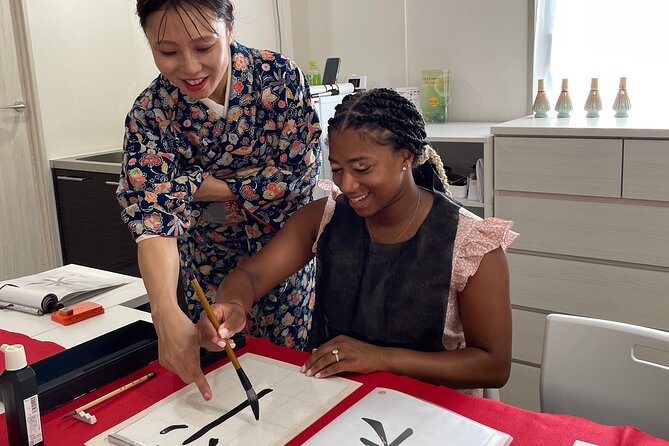
The instruction is given in English, so you can ask questions and follow the demonstrations without needing Japanese language skills. Fumi’s approach is especially suitable if you have never tried calligraphy. She is described as patient and focused on helping beginners succeed, a quality that matters when the brush feels unfamiliar in your hand.
Learning posture and brush control
The class also places importance on posture. That may sound formal, but it is practical. Your position affects how freely your arm moves and how evenly you can guide the brush. You learn that calligraphy is not just a wrist exercise.
You can take part while sitting on a chair. This is a useful detail for anyone who finds traditional floor seating difficult or tiring. You still learn the importance of sitting properly and keeping your body steady, but you do not need to worry about staying in a rigid position on the floor.
The first strokes may feel awkward. A brush does not behave like a ballpoint pen, and a kanji character is built from separate movements rather than one quick sketch. The instructor’s guidance helps you see where to place the brush, how to move it, and how to keep your posture from working against you.
I like that the session does not treat inexperience as a problem. You are given samples prepared by the instructor, then asked to choose a kanji you like and imitate it. This makes the task approachable. You do not need to know which characters are appropriate, how many strokes they contain, or how to find a suitable design before you arrive.
Practicing before you make the keepsake
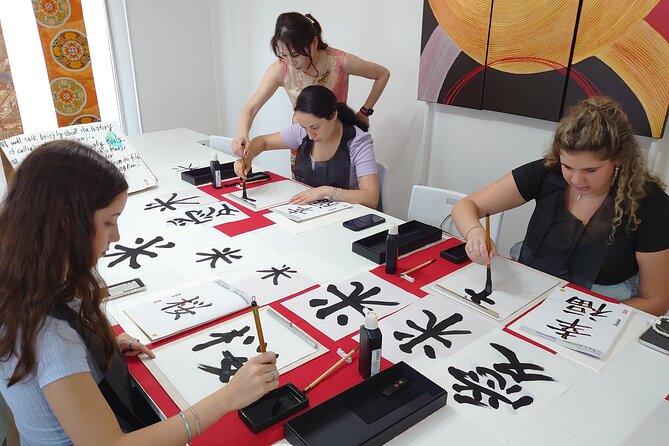
After the explanation and demonstration, you practice. This is where the class becomes more than a photo opportunity. You can make mistakes on practice paper, adjust your brush handling, and begin to understand how pressure changes the width and shape of each stroke.
The amount of practice is one of the experience’s strongest points. The information provided for the class says you can practice as much as you want, which gives you room to settle in before producing the final work. That is important because your first attempt may be more about controlling the brush than expressing the character.
You will gradually notice your attention narrowing to the paper. The activity’s promise of a calmer mind makes sense here, not because the class turns into a formal meditation session, but because the task leaves little room for rushing. You watch the brush, think about the next stroke, and correct your movement.
This is also a good activity for families. A daughter particularly enjoyed the session, and the hands-on format gives children something concrete to do. Still, the class centers on careful writing, so children who need constant movement may find the hour slow. The small group limit of eight should help keep the instruction personal.
More traditional craft workshops:
- 1.5〜2 Hours Traditional Kintsugi Work Shop in Namba Osaka
★ 5.0 · 75 reviews - Osaka: Private Japanese Calligraphy Experience
★ 5.0 · 66 reviews - From Osaka: Sakai Knife Maker or Blacksmith Walking Tour
★ 4.9 · 64 reviews - Osaka: Traditional Japanese Ceramics Private Experience
★ 5.0 · 57 reviews
Selecting your kanji
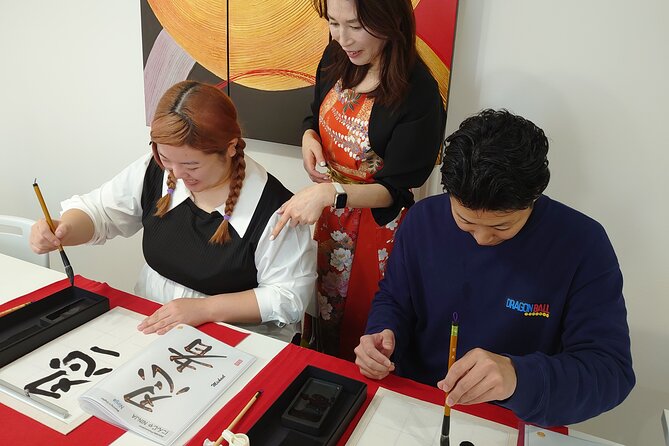
The prepared samples remove one of the biggest worries for beginners: choosing a character. You can look through the instructor’s examples and select a kanji that appeals to you.
The information does not specify the full range of available characters, so you should not assume that a particular word or name will be offered. If you have a specific kanji in mind, it is sensible to ask the provider before booking. Otherwise, choosing from the prepared samples keeps the process simple and avoids turning the class into a language lesson.
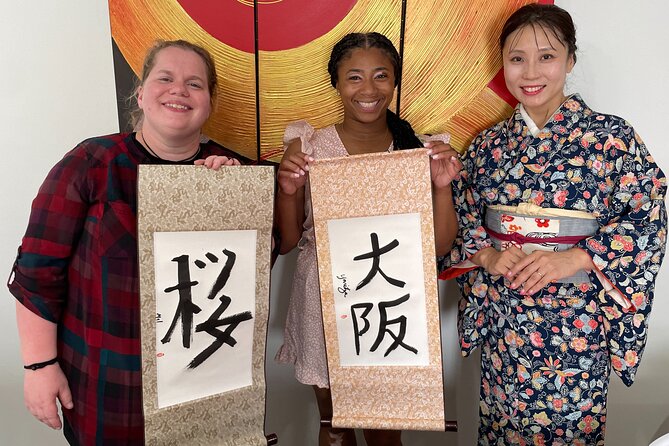
Your chosen character becomes the focus of the practice period and the final piece. That gives the finished scroll a personal connection to your time in Osaka. The souvenir is not a generic item picked from a shop shelf. You create it during the class, with your name and a stamp added at the end.
I find this more meaningful than a quick brush demonstration where the instructor produces the only finished work. Here, you take part in each stage. The result may not look perfect, and that is part of the charm. It records your first attempt at a traditional Japanese art.
Writing the final hanging scroll
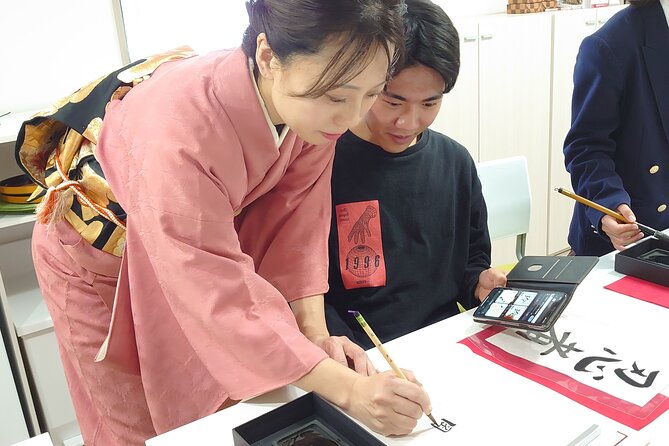
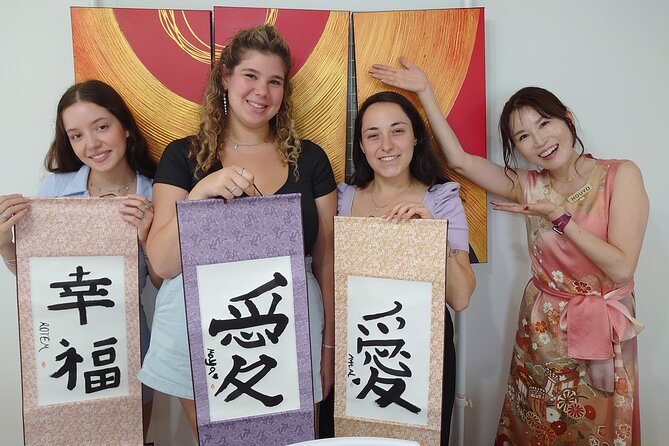
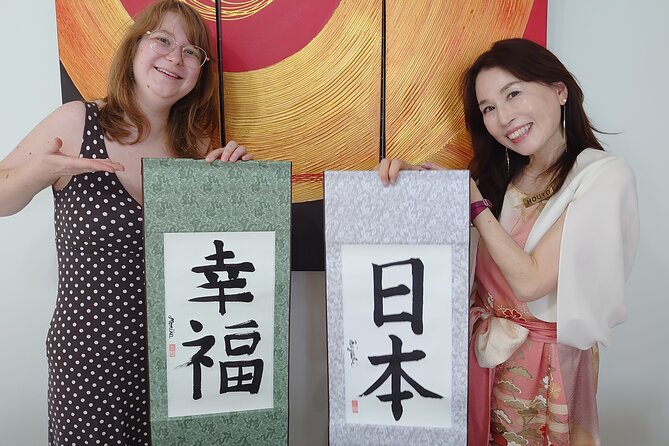
The final stage is the moment to slow down again. Once you have practiced your selected kanji, you write it on a beautiful hanging scroll. You then add your name and stamp the work to finish it.
The scroll changes the feel of the activity. Practice sheets are useful, but a hanging scroll is something you can display or keep as a lasting memory of Japan. It also gives the class a clear finish. You move from learning the tools, to copying a sample, to making a piece in your own hand.
Do not expect a museum-quality artwork after a single hour. The value is in the process and the personal connection. Your lines may vary, and the character may show signs of a beginner’s hand. That does not make the scroll a failure. It shows that you tried a real traditional craft under instruction.
The addition of your name and a stamp gives the finished work a ceremonial touch. It also helps distinguish it from a calligraphy print. You leave with something you made, not just something you watched.
Why the one-hour format works
One hour is short, but it is also a practical length for a packed Osaka schedule. You can fit the class between sightseeing, shopping, and a meal without giving up half a day.
The compact format keeps the experience focused. You learn the background, study the tools, practice, and create the scroll without a long break between stages. If you are curious about calligraphy but unsure about committing to a longer workshop, this is a sensible introduction.
The tradeoff is depth. You will not have time to study many writing styles, work through a large selection of characters, or develop advanced technique. The class offers a first step, not a complete education in Japanese calligraphy.
I would plan to arrive near the meeting point with enough time to find 1-chōme-5-12 Nishishinsaibashi. The experience begins and ends there. It is near public transportation, but the supplied details do not name a particular station or give walking times, so check the exact route before you set out.
Cost, group size, and overall value
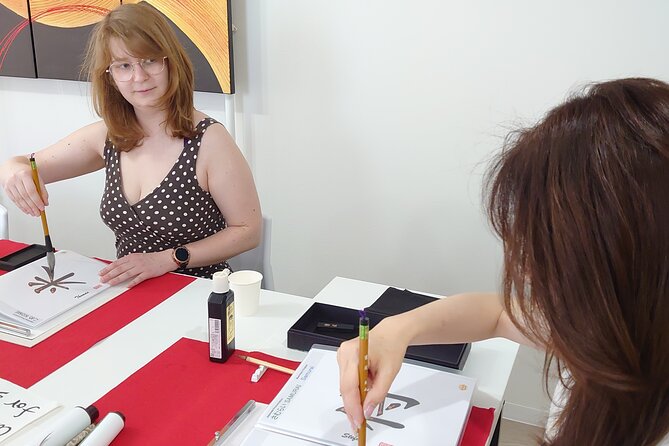
The price is $45.52 per person. That is more than you might pay for a casual souvenir, but the fee covers instruction, use of traditional tools, practice, and a finished hanging scroll to take home.
The value depends on what you want from the hour. If you only want a name written in Japanese, this is probably more activity than you need. If you want to understand the brush process and make your own piece, the price is easier to justify.
A maximum of eight participants is another positive point. This is not a huge demonstration where you sit at the back and watch someone else work. A small group gives the instructor a better chance to correct your grip, posture, and brush movement. The class size also suits families or pairs who want a shared activity without losing all personal attention.
The high rating attached to the experience is based on only three published ratings, so I would not treat it as a broad statistical measure. Still, the repeated praise is specific: Fumi is patient, the teaching is clear, practice is available, and the finished scroll makes a satisfying souvenir. Those are the points that matter most for this kind of workshop.
Who will enjoy this calligraphy session
I would recommend this experience to you if you want a calm cultural activity near Osaka’s main entertainment district. It works particularly well for first-timers, since you receive samples to copy and instruction in English.
It also suits couples, families, and solo participants who prefer making something together instead of only looking at sights. The chair seating helps if floor-based activities are not comfortable, and the small group size should make the class less intimidating.
You may want to skip it if you are seeking a long, advanced lesson or a broad survey of Japanese art. The session is brief and focused on one finished kanji. You should also keep your expectations realistic about the scroll: it is a personal beginner’s work, not a professionally produced artwork.
The activity is also a good fit late in a busy day. Calligraphy asks for patience, so you may appreciate the contrast after shopping or sightseeing. At the same time, if you arrive rushed or distracted, you may get less from the quiet concentration the class is meant to encourage.
Practical details that affect your choice
Confirmation is sent within 48 hours of booking, subject to availability. Since the activity is often booked about 23 days ahead, it makes sense to reserve before your Osaka plans become fixed, especially if you need a particular day.
The experience accepts mobile tickets, making the entry process simple. Service animals are allowed, and most people can participate. The class begins and ends at the same Nishishinsaibashi meeting point, so you do not need to arrange separate transportation back to your hotel or the next stop.
Free cancellation is available if you cancel at least 24 hours before the local start time. Changes or cancellations made within 24 hours are not accepted for a refund, so check your schedule before the final day.
Should you book the MIYABI Culture Salon session?
Book it if you want a hands-on Japanese souvenir and a calm break near Dotonbori. Fumi’s patient English instruction, the chance to practice before the final piece, and the chair seating make this a friendly introduction for beginners.
Skip it if you want advanced calligraphy training, a long cultural lecture, or a choice of many different art forms. For most people, the best reason to book is simple: in one focused hour, you learn a traditional skill and leave with a hanging scroll made by your own hand.
FAQ
How long does the calligraphy experience last?
The activity lasts approximately one hour.
Where does the experience begin and end?
It begins at 1-chōme-5-12 Nishishinsaibashi, Chuo Ward, Osaka, 542-0086, Japan, and ends back at the same meeting point.
Is the instruction available in English?
Yes. Experienced Japanese instructors teach calligraphy techniques in English. Fumi is identified as the instructor in the provided experience details.
Do I need previous calligraphy experience?
No. Beginners can choose a kanji from samples prepared by the instructor and practice copying it.
What do I take home?
At the end, you write your selected kanji on a hanging scroll, add your name, and stamp it. You can take the completed scroll home.
Can I cancel for a full refund?
Yes, if you cancel at least 24 hours before the experience start time. Cancellations or changes made less than 24 hours before the local start time are not accepted for a refund.
Just added around Osaka
- Nara Day Trip from Osaka with a Licensed Guide★ 5.0 · 3 reviews
- Osaka Early Morning Osaka Castle Tour Avoid Crowds★ 5.0 · 3 reviews
- Guided Tour of Some Attractions in Osaka by Private Car★ 5.0 · 3 reviews
- Private Transfer Between Kyoto and Kansai Airport KIX★ 5.0 · 3 reviews
- Shared Arrival Transfer: Osaka Itami Airport to Osaka City★ 5.0 · 3 reviews
- Osaka: Sushi Making Class and Dotonbori Food Tour★ 4.7 · 3 reviews
- Osaka Night Photography Workshop★ 5.0 · 3 reviews
- Kyoto Full day Tour Kinkakuji, Kiyomizu-dera and Fushimi Inari★ 4.5 · 3 reviews
Dotonbori & Namba Tours, compared.

Osaka Local Foodie Walking Tour in Dotonbori and Shinsekai
Read our review →
Dotonbori District River Cruise with Drink Discount
Read our review →
Ultimate Osaka Walking Tour: Castle, Dotonbori & Hidden Gems
Read our review →


Dotonbori River Cruise with Glico Sign & Neon Views
Read our review →
Browse the lists this tour appears in