
Reviewed · OSAKA SAMURAI & NINJA EXPERIENCES
Learn The Katana ‘Sword’ Technique of Samurai and Ninja
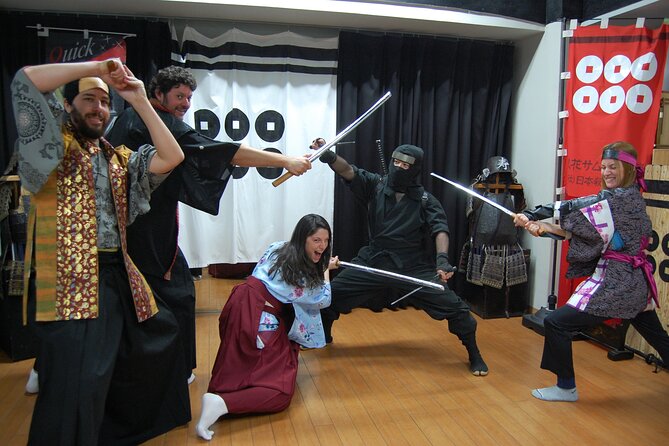
Three Samurai and a Ninja open this Osaka experience with a fighting performance, then turn the room over to you. You dress in a kimono, ninja costume, or samurai armor and learn how to hold a katana, perform eight basic katas, and take part in a staged battle.
I like the mix of costume, movement, and theater. You are not simply standing beside a sword for a quick photograph. You learn posture, balance, focus, and a short routine before joining a group scene. I also like the small maximum group of 10, which should give the instructor room to correct basic movements.
The main thing to keep in mind is that this is an entertaining stage-combat lesson, not a serious martial arts course. The instructors are stage actors with a background in kendo, according to one detailed assessment, so book it for fun, performance, and a taste of Samurai and Ninja culture rather than formal combat training.
In This Review
- Key details before you book
- What this Osaka class is really about
- The opening performance gives you a target
- Dressing in kimono, ninja clothing, or armor
- Learning the katana and eight basic katas
- Tate battle training: stage action rather than combat
- Rubber shuriken throwing adds a lighter finish
- The final scene puts you in the cast
- What makes the price worthwhile
- Who will enjoy it most
- Group size, timing, and practical planning
- Final verdict: book it for theater, not combat
- FAQ
- Where does the katana and Ninja experience take place?
- How long does the experience last?
- What does the class include?
- Do I need to bring my own costume or sword?
- What costume choices are available?
- How many people can join the class?
- Is transportation included?
Key details before you book
- A three-Samurai and one-Ninja performance starts the lesson, giving you a clear example of the poses and movement you will later practice.
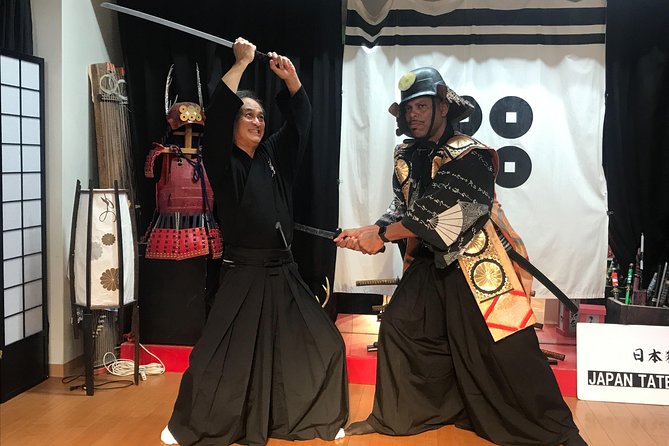
- You learn eight katana katas, including how to hold the sword and record your movements on video.
- Your costume is part of the activity, with a kimono, ninja outfit, or samurai armor available for the role you choose.
- The tate section teaches stage sword technique, using posture, balance, and mental focus rather than real fighting.
- Rubber shuriken are used for throwing practice, making this suitable for a broad range of participants.
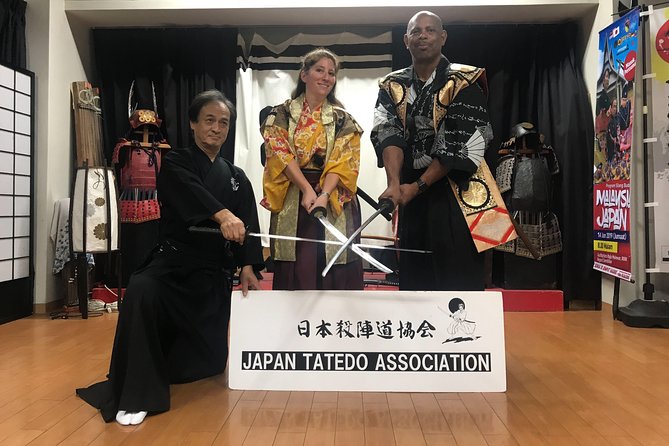
- The class meets at the Japan Tatedo Association in Osaka, and transportation to the venue is not included.
What this Osaka class is really about
This is a compact performance workshop built around the image of the Japanese warrior. The experience combines a demonstration, costume dressing, sword instruction, staged combat, shuriken throwing, and photographs.
That combination matters. A standard cultural class might explain Samurai traditions or show you a costume. Here, you get a physical role to play. You stand in position, move with a prop katana, and perform a scene with the rest of the group.
The tone is best described as playful and theatrical. You will be asked to look the part and perform the part. If you want a demanding lesson in martial arts technique, this will feel light. If you want an active Osaka memory that works well for families, friends, and first-time visitors to Japan, it has a lot going for it.
The activity is listed as approximately one hour, while the fuller description refers to a 90-minute lesson. Allow some flexibility in your schedule and check the confirmed timing when you book. Either way, this is a short experience that can fit neatly between sightseeing stops in Osaka.
More samurai and ninja experiences:
- Samurai Training Experience KENDO in Osaka
★ 5.0 · 515 reviews - OSAKA NIGHT FUSION Japanese Taiko Kabuki Samurai Dance Show
★ 4.8 · 155 reviews - Osaka: Samurai Training Experience KENDO in Osaka
★ 5.0 · 111 reviews
The opening performance gives you a target
The lesson begins with a fighting performance by three Samurai and a Ninja. This is more than a curtain-raiser. It shows you the dramatic stances, controlled cuts, and expressive poses that shape the rest of the session.
I find this opening useful because it sets the mood without asking you to understand a long explanation first. You see the kind of movement you will later copy. It also helps explain why the class focuses on tate, a style of staged sword action that depends on clean lines, timing, balance, and presentation.
Do not expect a historical lecture or a full account of Samurai and Ninja life. The attraction is movement and role-play. The performance gives you a taste of action theater, then invites you into the scene.
Dressing in kimono, ninja clothing, or armor
After the demonstration, you dress for the role. The experience includes a rental costume, with options described as a traditional kimono, ninja costume, or samurai armor. The detailed schedule also notes learning how to wear a kimono and hakama.
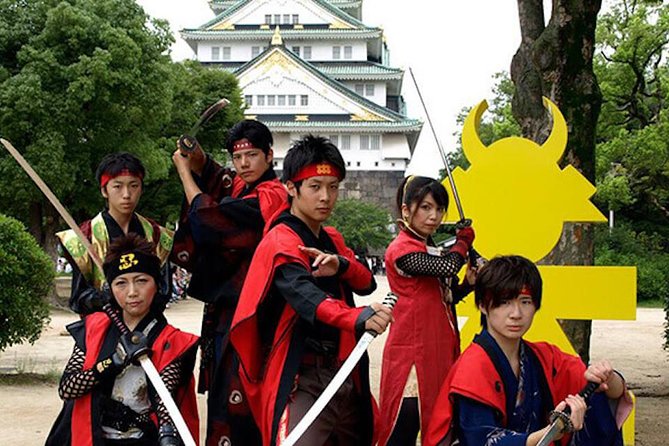
This is one of the strongest parts for photographs. Clothing changes the feel of the lesson, and the final pictures give you something more personal than a standard Osaka attraction snapshot. You are not only watching a Samurai performance. You are dressed for your own short appearance.
The costume also affects your expectations. This is a theatrical activity, so the visual effect matters. You will be preparing for a scene as much as for a sword exercise. If you are booking for children or a group of friends, the outfit selection can become part of the fun.
The supplied information does not specify how long dressing takes or whether every costume size is available. If costume fit is important to you, ask the provider before booking. The activity is capped at 10 people, which should keep the group from feeling too crowded, but costume arrangements may still take part of the lesson.
Learning the katana and eight basic katas
The instructor teaches you how to hold the katana and introduces eight katas. In this setting, kata means a set form or movement pattern. You will work on how to stand, how to position the sword, and how to make the action look controlled.
The lesson also includes video recording, so you can capture your movements rather than rely only on memory. That is a nice touch for an activity built around performance. You can see the finished sequence later and share it with friends or family.
The word katana can make this sound more serious than it is. The supplied information describes a traditional sword-technique class, but the detailed feedback makes clear that it is not intended as a full martial arts course. You will learn a short set of movements in a limited session, not develop a complete fighting system.
That distinction is important for value. At $162.59 per person, the price is high for a one-hour activity if you measure it against a basic class. It becomes easier to justify if you value the costume, live performance, guided instruction, video, photographs, and group scene as one package.
A completely different way to spend a day in Osaka:
- Osaka Go Karting Tour with Funny Costume
★ 5.0 · 2,658 reviews - Osaka Castle: Museum and Tower Entry Ticket
★ 4.5 · 2,380 reviews - Osaka: Shinsekai Food Tour with 13-15 Dishes at 5 Eateries
★ 4.8 · 2,204 reviews - Osaka Food Tour: 13 Dishes at 5 Local Eateries
★ 5.0 · 2,149 reviews
Tate battle training: stage action rather than combat
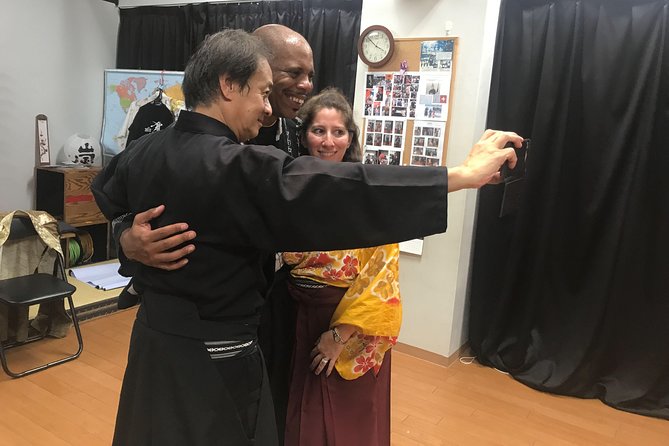
The tate battle experience is the central theatrical moment. Tate is built for performance, so the aim is controlled movement that looks convincing and stays coordinated with the group.
You will work with posture, balance, and mental focus. These are useful foundations for making the sword action look steady. The class is not presented as a free-for-all fight, and you should not expect contact combat or advanced weapons training.
This part should suit you if you enjoy being directed and performing in front of others. It may feel awkward for a few minutes, especially if you are not used to striking poses or moving as part of a scene. The instructors are described as patient and gracious, which matters in a lesson where the emphasis is on participation rather than perfection.
The most important advice is to lean into the theatrical side. Use the stance, hold the pose, follow the sequence, and do not worry about looking like a trained Samurai after one short class. The activity is designed to help you become part of the show.
Rubber shuriken throwing adds a lighter finish
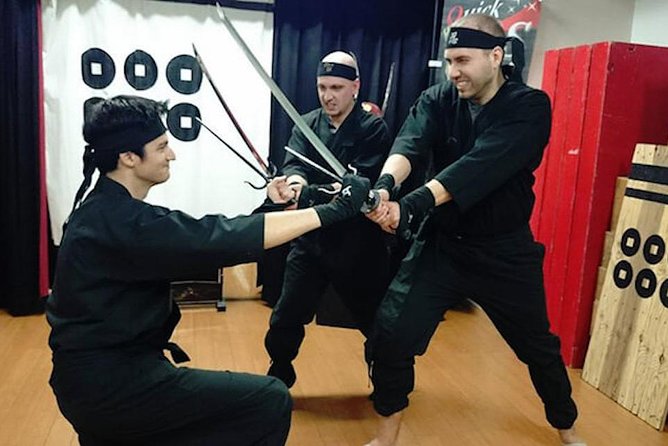
The shuriken section lets you try throwing a rubber version of the Ninja star. The use of rubber makes the activity more approachable and keeps the focus on the experience rather than on weapon handling.
This is a small part of the lesson, but it broadens the appeal. Someone who prefers the Ninja side to the Samurai side gets a clear activity of their own. Families and mixed groups can also enjoy the change of pace after the more structured sword forms.
The supplied details do not state how many throws each person gets, how far away the target is, or how the scoring works. Treat it as a brief hands-on demonstration rather than a full throwing workshop.
The final scene puts you in the cast
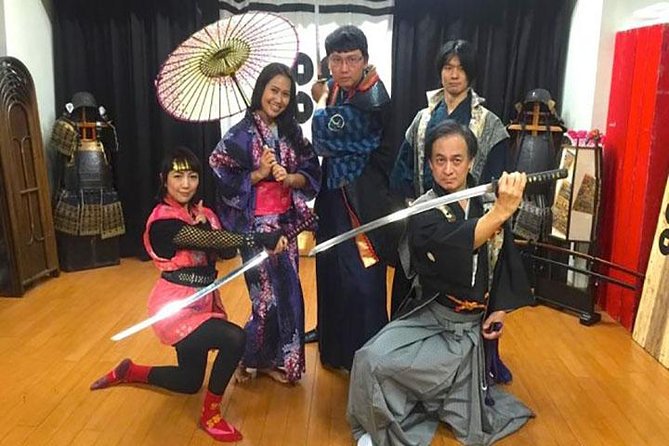
At the end, everyone takes part in a ninja scene together. This is where the earlier lessons connect. You have the costume, the sword posture, the basic kata work, and the stage-combat ideas. Now you use them as part of a short group performance.
I like this format because it gives the lesson a clear payoff. You are not left with a few disconnected activities. The class builds toward a shared finale, and the photo time afterward helps preserve the moment.
The group setting can be an advantage or a drawback. You do not have to perform alone, which makes the activity less intimidating. On the other hand, your personal time in the spotlight may be limited because up to 10 people can join. The description says everyone becomes a leading actor in the show, but the exact amount of individual attention will depend on the group.
Bring the right attitude. This is not a private Samurai lesson with a master. It is a short ensemble scene where the fun comes from doing it together.
What makes the price worthwhile
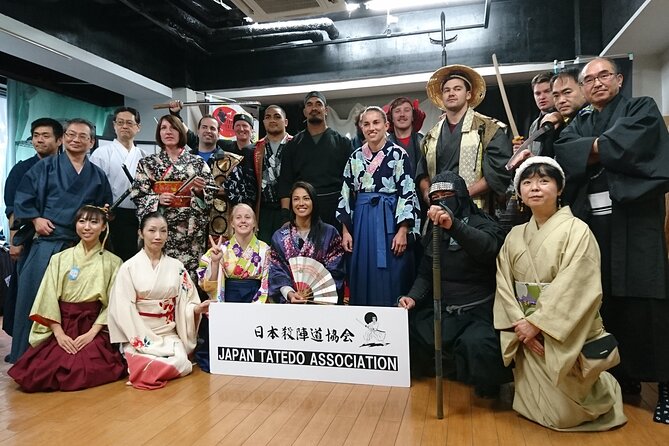
The listed cost is $162.59 per person. For a one-hour lesson, that is not a budget activity. You are paying for more than sword instruction, though.
The price includes:
- A local instructor
- Rental costume
- Katana handling and eight katas
- Tate battle practice
- Rubber shuriken throwing
- A Samurai and Ninja performance
- Participation in a final scene
- Photo time
There is no hotel pickup, drop-off, or transportation included. You must make your own way to the meeting point at the Imai Building, 1-chōme-1-27 Kitahorie, Nishi Ward, Osaka. The location is near public transportation, so it should be possible to fit into an Osaka day plan, but the route and fare are yours to arrange.
I would judge the price by asking what kind of memory you want. If you only want to hold a sword for a photograph, this is expensive. If you want instruction, costumes, live action, a group performance, and a guided activity in one booking, the value is more reasonable.
Group discounts are available, so the calculation may improve for families or friends booking together. The small group limit also gives the class a more personal feel than a large commercial show, though the available data does not state the exact discount.
Who will enjoy it most
This activity is a good match for you if you:
- Want an active cultural experience rather than a museum visit
- Enjoy costumes, theater, and playful role-play
- Are visiting Osaka with family or friends
- Like taking photographs during an activity
- Want a short experience that fits around other plans
- Have never handled a katana and want an introductory lesson
Children and adults can participate, since most people are able to take part, but the supplied details do not give a minimum age. Ask before booking if you are planning the activity for young children.
You should choose something else if you want a serious martial arts course, advanced kendo instruction, or a long technical lesson. One detailed assessment makes this limit clear: the class is run by stage actors with kendo backgrounds, not by instructors offering a formal martial arts program.
That is not a flaw if you know what you are buying. It simply defines the experience. You are learning how to present Samurai and Ninja movement in a safe, entertaining setting.
Group size, timing, and practical planning
The maximum group size is 10 people. That is small enough to keep the atmosphere manageable and should give the instructor a chance to guide the group through the movements. It also means the final scene will have enough people to feel like a real group performance without becoming a crowd.
The timing needs a little care. The experience is described in one place as about one hour and elsewhere as a 90-minute lesson. Plan around the longer figure if you have a restaurant reservation, train departure, or another timed attraction afterward.
You receive booking confirmation within 48 hours, subject to availability. Since the activity is booked an average of 112 days ahead, it is sensible to reserve early if your Osaka dates are fixed. That advance-booking pattern is especially relevant for weekends, family trips, or a group that needs a particular time.
The meeting point is the Imai Building in Kitahorie. Transportation is not included, and the activity returns to the same meeting point. There is no hotel pickup or drop-off, so allow time to reach Kitahorie before the start.
The cancellation terms are fairly strict. You can receive a full refund if you cancel at least six full days before the start time. Cancellation two to six full days ahead brings a 50 percent refund, while cancellation less than two full days before the activity receives no refund. The cut-off uses Osaka local time.
Final verdict: book it for theater, not combat
I would book this Osaka experience if I wanted a lively, photo-friendly activity with a strong performance element. The opening Samurai and Ninja show, costume choices, eight katana katas, rubber shuriken practice, and final group scene create a clear beginning, middle, and end.
I would not book it expecting a serious martial arts lesson. The one-hour format, stage-actor instructors, and focus on tate performance make this an introduction to Samurai and Ninja theater. At $162.59, it needs to be more than a quick costume photo, and it is, but only if you value the full package.
For families, friends, and anyone who enjoys stepping into a role for an hour, this is an easy activity to recommend. For dedicated martial arts students, the better choice is a formal class with a longer training focus. Know that difference before you pay, and this can become one of the more memorable short activities in Osaka.
FAQ
Where does the katana and Ninja experience take place?
The class takes place at the Japan Tatedo Association. The meeting point is the Imai Building, 1-chōme-1-27 Kitahorie, Nishi Ward, Osaka, 550-0014, Japan.
How long does the experience last?
The details describe a lesson of about 60 minutes, while another description refers to a 90-minute lesson. Plan for some variation and confirm the timing when your booking is confirmed.
What does the class include?
The experience includes a rental costume and a local instructor. The activities include katana handling, eight katas, tate battle practice, rubber shuriken throwing, a final group scene, and photo time.
Do I need to bring my own costume or sword?
No. A rental costume is included, and the class provides the equipment used for the sword and shuriken activities.
What costume choices are available?
You can dress in a traditional kimono, ninja costume, or samurai armor. The detailed schedule also refers to learning how to wear a kimono and hakama.
How many people can join the class?
The activity has a maximum of 10 participants.
Is transportation included?
No. Transportation to and from the attraction is not included, and there is no hotel pickup or drop-off. The activity ends back at the meeting point.
Just added around Osaka
- Nara Day Trip from Osaka with a Licensed Guide★ 5.0 · 3 reviews
- Osaka Early Morning Osaka Castle Tour Avoid Crowds★ 5.0 · 3 reviews
- Guided Tour of Some Attractions in Osaka by Private Car★ 5.0 · 3 reviews
- Private Transfer Between Kyoto and Kansai Airport KIX★ 5.0 · 3 reviews
- Shared Arrival Transfer: Osaka Itami Airport to Osaka City★ 5.0 · 3 reviews
- Osaka: Sushi Making Class and Dotonbori Food Tour★ 4.7 · 3 reviews
- Osaka Night Photography Workshop★ 5.0 · 3 reviews
- Kyoto Full day Tour Kinkakuji, Kiyomizu-dera and Fushimi Inari★ 4.5 · 3 reviews
Osaka Samurai & Ninja Experiences, compared.

Osaka 2-Hour Genuine Kendo / Samurai Experience In Japan
Read our review →
Learn Bushido – Trial Slashing with Samurai Sword
Read our review →
Samurai Show, Tea Ceremony, Japanese Traditional Activities
Read our review →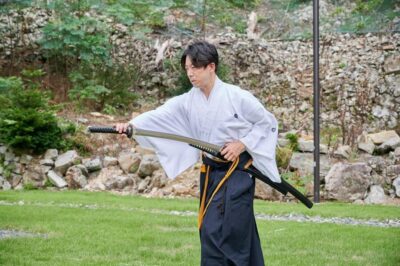
Private Samurai Experience – Train with Sword Master
Read our review →
Honor – Experience Samurai & traditional Culture to the fullest
Read our review →Browse the lists this tour appears in