
Reviewed · OKONOMIYAKI & TAKOYAKI CLASSES
Osaka Okonomiyaki Cooking Experience for Families & Groups
Osaka’s favorite street food becomes your hands-on lunch at this lively 90-minute okonomiyaki class. You mix the batter, choose from six toppings, and learn the tricky little flip on a hot teppan, all while wearing a colorful happi coat.
I like the beginner-friendly instruction and the festival games, which give children something to do between cooking steps. I also like the personal touches: photos are sent to your phone, and you receive an Okonomiyaki Master certificate.
The main consideration is that extra drinks, snacks, and alcohol cost more. If your group wants a full meal with several drinks, the final bill will rise above the $23 starting price.
In This Review
- Key points
- Cooking Osaka’s favorite comfort food
- Choosing toppings and building your pancake
- The teppan flip is the moment to watch
- Happi coats and festival games add local character
- Photos and the Okonomiyaki Master certificate
- What the 90-minute schedule means for you
- Is $23 a fair price?
- Who will enjoy this most?
- Practical booking advice before you go
- Should you book this Osaka cooking experience?
- FAQ
- How long does the okonomiyaki cooking experience last?
- How much does the experience cost?
- Is the instruction available in English?
- What is included in the experience?
- Are drinks included?
- Can I cancel for a full refund?
Key points
- Make okonomiyaki from scratch: Mix, top, cook, and flip your own Japanese savory pancake.
- Six daily toppings: Choose from a changing selection with vegetarian and seafood choices available.
- Festival-style setting: Wear a colorful happi coat and try the traditional super ball scooping game.
- English instruction: A local host guides the cooking, sauces, and flipping technique.
- Useful family activity: Children can take part in mixing, decorating, cooking, and the game.
- Small souvenirs included: Photos are sent to your phone, and you receive an Okonomiyaki Master certificate.
Cooking Osaka’s favorite comfort food
Okonomiyaki is often translated as whatever you like, grilled, which neatly explains the appeal. It is a savory Japanese pancake cooked on a hot iron griddle, then finished with sauces and toppings. In Osaka, it is a familiar everyday food, not a formal dish reserved for special occasions.
This experience lets you take part rather than simply watch someone cook. You work with the ingredients, decide how to finish the dish, and try the signature flipping move with guidance from an English-speaking host. That makes the class useful for first-time visitors who want a simple introduction to Japanese food culture.
You should expect a cheerful, informal session rather than a serious culinary school lesson. The emphasis is on making food, having a laugh, and giving everyone a chance to participate. That balance works especially well for families and groups with mixed ages or cooking skills.
The activity provider is TAKOYAKI BABY, and the cooking experience is designed for beginners. You do not need previous knowledge of Japanese food or special kitchen skills to take part.
More okonomiyaki and takoyaki classes:
- Osaka Cooking Class: Okonomiyaki &Japanese cuisines experience
★ 5.0 · 261 reviews - Osaka Sake Tasting with Takoyaki Cooking
★ 5.0 · 156 reviews - Osaka Sake Tasting & Takoyaki Cooking Experience
★ 5.0 · 149 reviews
Choosing toppings and building your pancake
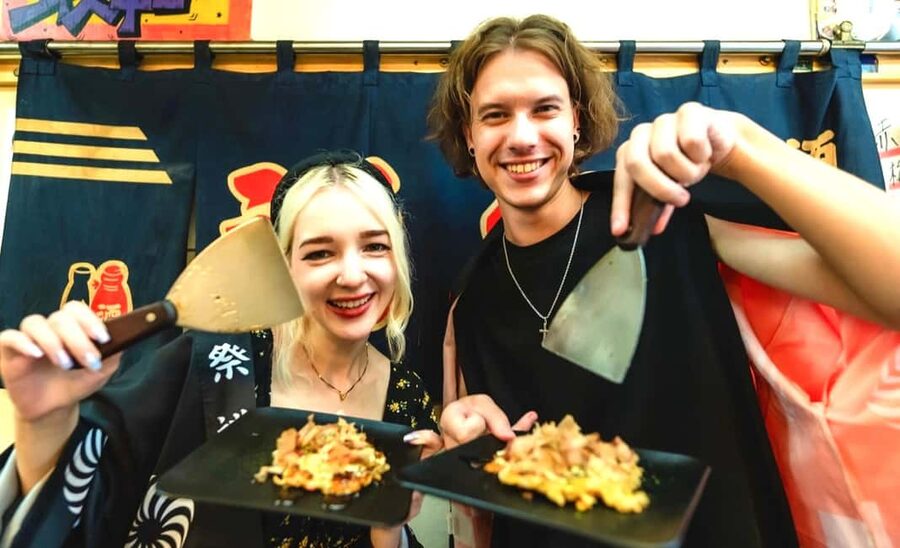
A key part of the session is choosing from six toppings available that day. The selection changes, so you should not book expecting one exact ingredient list. Vegetarian and seafood options are included among the choices, giving you some control if you have a preference.
That choice matters more than it may sound. Okonomiyaki is meant to be adaptable, and selecting your own toppings helps you understand why the dish has such a broad appeal. You can keep things simple or create a combination that suits your taste.
The class teaches you to make the dish completely from scratch. You will work with the mixture before it reaches the teppan, then add your selected toppings and cook it under the host’s direction. The cooking surface is part of the experience. You are not preparing the food in a back kitchen and receiving it later.
The host also introduces different sauces, including classic, sweet, and spicy choices. Sauces are one of the easiest ways to change the character of okonomiyaki, so this tasting element gives you a quick lesson in how the same pancake can taste quite different from one plate to the next.
I would encourage you to ask questions if you are unsure about a topping or sauce. The class is in English, and the format is built around guidance, so you are not expected to guess your way through the cooking.
The teppan flip is the moment to watch
The most entertaining part of the class is likely to be the flip. Okonomiyaki looks sturdy once cooked, but turning it neatly takes a little timing and confidence. Your host guides you through the technique using the real teppan, rather than demonstrating on a separate stove far from the group.
This is where the activity feels different from a standard food tasting. You have a small task to manage, and the result depends partly on your own handling. If your first flip is not perfect, that is part of the fun. The class is aimed at beginners, so the point is participation, not restaurant-level presentation.
The host keeps the cooking social and light. One recent booking note specifically praises Jailor as a great host, while another describes the guide as funny and positive during both okonomiyaki and takoyaki preparation. The available details focus on okonomiyaki, so you should not assume takoyaki is part of every session, but the host’s friendly approach appears to be an important part of the format.
Once the food is cooked, you finish it with your chosen sauces and eat what you made. That immediate reward helps keep children interested, especially those who might lose patience during a longer cooking lesson.
Happi coats and festival games add local character
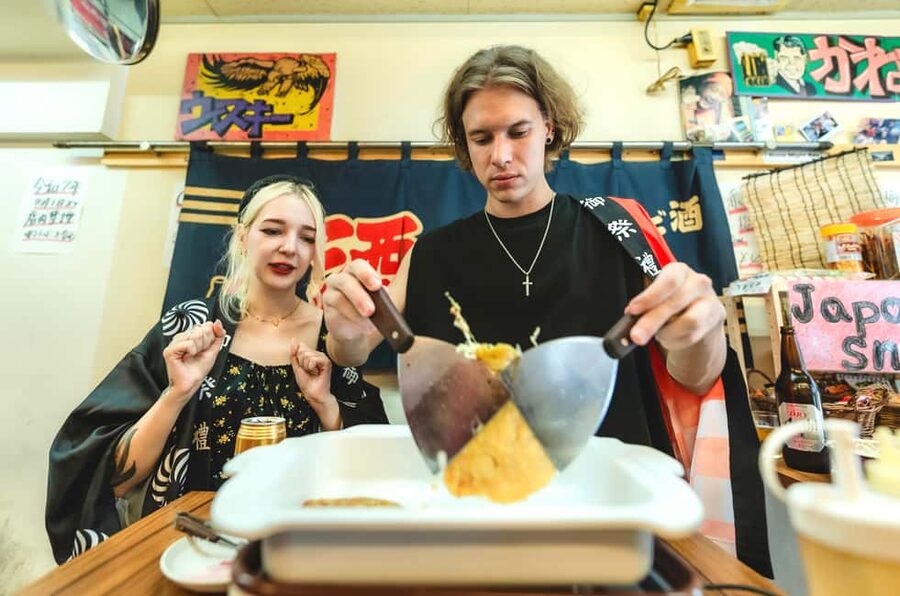
The colorful happi coat is more than a costume for photographs. Happi coats are associated with Japanese festivals and local celebrations, so wearing one gives the class a clear festival theme. It also helps the activity feel distinct from a regular meal at a restaurant.
The super ball scooping game adds another traditional festival touch. This is a simple Japanese fairground game in which you try to scoop small floating balls with a delicate paper scoop. The activity information does not specify how many balls you can keep or the exact game rules, so treat it as a playful extra rather than a competition with a guaranteed prize.
For families, this is a smart addition. The cooking gives children a practical task, while the game breaks up the time spent waiting for food to cook. Adults can enjoy the food and photos, and children get an activity that does not depend entirely on sitting still.
The festival elements also make the class appealing for groups of friends or couples who want more than a standard restaurant dinner. You can wear the coat, take photos, and leave with a certificate that records the experience in a fun way.
More Japanese home cooking classes:
- Osaka: Ramen and Gyoza Cooking Class in Dotonbori
★ 5.0 · 378 reviews - Osaka: Sumo Stage Show with Bento or Snack + Fight & Photo
★ 4.3 · 364 reviews - Osaka: Traditional Mochi Pounding Experience with Tasting
★ 4.9 · 306 reviews - Ramen and Gyoza Cooking Class in Osaka
★ 5.0 · 202 reviews
Photos and the Okonomiyaki Master certificate
Photos are included and sent to your phone as a souvenir. That is useful because cooking on a hot griddle keeps your hands occupied, making it hard to photograph the best moments yourself. You can concentrate on mixing, flipping, and eating instead of constantly reaching for your phone.
The Okonomiyaki Master certificate is clearly meant as a playful keepsake. It will not replace a formal cooking qualification, but it gives children and groups something physical to take away. For a family holiday, that small certificate can be more memorable than another ordinary restaurant receipt.
I like that these extras connect to the activity itself. The photos capture the process, and the certificate marks the completion of the cooking challenge. Neither is a major reason to book on its own, but both add value to a reasonably priced experience.
What the 90-minute schedule means for you
Ninety minutes is long enough to learn the basic process, cook, eat, play the festival game, and take photos without turning the activity into a half-day commitment. That timing fits neatly into a busy Osaka sightseeing plan.
The exact starting times depend on availability. You should check the schedule before booking, especially if you are arranging this around a museum visit, train departure, or evening reservation. The meeting point is described using a Family Mart diagonally ahead to the left, so keep that landmark in mind when finding the venue.
The English-speaking instructor is important for a hands-on class. You need to understand when to add ingredients, how to handle the teppan, and when to attempt the flip. English instruction also makes it easier to ask about toppings and sauces.
The information does not give a group-size limit. That means you should not assume this is a private class or a very small lesson. If personal attention matters to you, ask the provider about the group arrangement before booking.
Is $23 a fair price?
At $23 per person, this is good value if you want food plus an activity rather than just a meal. You receive instruction, an okonomiyaki meal, use of a happi coat, the super ball game, photos, and a certificate. The 90-minute format also gives you a defined experience without taking over your day.
The price is less attractive if you only want to eat okonomiyaki as cheaply as possible. Osaka has many restaurants where you can order the dish without paying for a class, a host, or added entertainment. Here, you are paying for the preparation, social setting, and memory-making.
Plan for possible extra costs. Drinks are available for purchase, while snacks and alcohol are not included. If you are booking for a family, the base price is easier to control because you can skip alcoholic drinks and order only what you need.
The rating attached to the activity is 4.9 from eight ratings, with especially strong praise for the guide, sauce, food, and family atmosphere. One family found that the children were keen to eat what they had prepared, which is a practical advantage if you are traveling with young eaters who resist unfamiliar meals.
Who will enjoy this most?
This is best for families, groups, couples, and solo visitors who want a relaxed food activity. It suits you if you like doing something with your hands and do not mind a little silliness around the cooking.
Families get the most from the mix of tasks. Children can choose toppings, help with preparation, attempt the flip with help, play super ball scooping, and receive a certificate. The food is also familiar enough in format to appeal to young diners, even if some toppings are new.
Couples and friends can treat it as a casual shared activity. The happi coats and photos give you something to remember, while the sauces and toppings create an easy point of conversation.
Solo visitors can join too. The activity is not restricted to families or large parties, and the English-speaking host provides structure if you are attending alone. You should be comfortable sharing a social cooking setting if the class is not private.
You may want to skip it if you prefer quiet dining, dislike group activities, or already have several cooking classes planned in Japan. It is playful and social, not a polished chef-led lesson focused on advanced technique.
Practical booking advice before you go
The meeting instructions use a Family Mart as a landmark, with the store diagonally ahead to the left. Have the meeting details ready on your phone and allow enough time to identify the correct spot.
You can cancel free of charge up to 24 hours before the activity for a full refund. The reserve-now, pay-later option lets you hold a place without paying immediately, which is useful while your Osaka schedule is still changing.
The activity lasts 90 minutes, but leave a little space around it if you have a strict appointment afterward. Cooking times, eating, photos, and the game all form part of the session, and rushing away would take some of the pleasure out of it.
If you have a food restriction beyond the stated vegetarian and seafood choices, ask before booking. The available information confirms those options but does not give a full allergen list or dietary policy.
Should you book this Osaka cooking experience?
Book it if you want a hands-on introduction to Osaka food, especially with children or friends. The combination of beginner instruction, six topping choices, sauce tasting, happi coats, festival games, photos, and a certificate gives you much more than a simple plate of okonomiyaki.
I would be most likely to recommend it early in an Osaka visit. You learn the basic idea behind one of the city’s best-known foods, then you can recognize the sauces, toppings, and teppan cooking style when you see them elsewhere.
Skip it if your priority is a quiet meal, a private lesson, or a detailed professional cooking course. For everyone else, the $23 price and compact 90-minute schedule make this an easy activity to fit into a family day or a relaxed evening plan.
FAQ
How long does the okonomiyaki cooking experience last?
The activity lasts 90 minutes.
How much does the experience cost?
The listed price is $23 per person.
Is the instruction available in English?
Yes. The instructor and activity information are in English.
What is included in the experience?
A local host guide, okonomiyaki, a festival-style happi coat, and the super ball scooping festival game are included. Photos are also taken and sent to your phone, and you receive an Okonomiyaki Master certificate.
Are drinks included?
Additional drinks are available for purchase but are not included. Snacks and alcohol are also sold separately.
Can I cancel for a full refund?
Yes. You can cancel up to 24 hours in advance for a full refund. You can also reserve now and pay later.
Just added around Osaka
- Nara Day Trip from Osaka with a Licensed Guide★ 5.0 · 3 reviews
- Osaka Early Morning Osaka Castle Tour Avoid Crowds★ 5.0 · 3 reviews
- Guided Tour of Some Attractions in Osaka by Private Car★ 5.0 · 3 reviews
- Private Transfer Between Kyoto and Kansai Airport KIX★ 5.0 · 3 reviews
- Shared Arrival Transfer: Osaka Itami Airport to Osaka City★ 5.0 · 3 reviews
- Osaka: Sushi Making Class and Dotonbori Food Tour★ 4.7 · 3 reviews
- Osaka Night Photography Workshop★ 5.0 · 3 reviews
- Kyoto Full day Tour Kinkakuji, Kiyomizu-dera and Fushimi Inari★ 4.5 · 3 reviews
Okonomiyaki & Takoyaki Classes, compared.

Osaka Cooking Class: Okonomiyaki &Japanese cuisines experience
Read our review →

Osaka Sake Tasting & Takoyaki Cooking Experience
Read our review →
Cooking Ramen&Gyoza/KatsuCurry/Bento/Okonomiyaki+Store Tour@Osaka
Read our review →
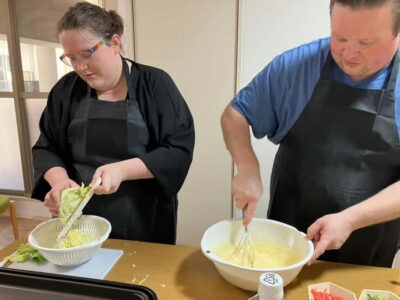
Cooking Class Okonomiyaki & Takoyaki course in Nanba
Read our review →
Osaka Okonomiyaki Cooking Class “Learn here and make it at home”
Read our review →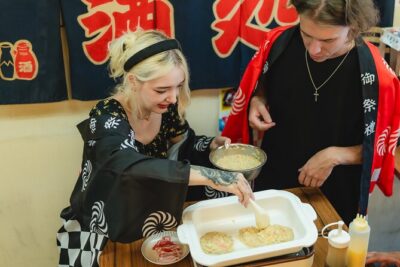
Osaka Street Food Festival :Takoyaki&Okonomiyaki for Families
Read our review →Browse the lists this tour appears in