
Reviewed · OSAKA HIGHLIGHTS & HIDDEN GEMS TOURS
Osaka Highlights: 4Hrs Guided Walking Tour with a Native Expert
Osaka’s character comes into focus when you move from the polished grounds of Osaka Castle to the old-fashioned streets around Tsutenkaku, then finish amid the neon and food stalls of Dotonbori. This four-hour walk gives you three very different views of the city without asking you to plan the route yourself.
I like the castle admission included in the $62.05 price, and I like the small maximum group size of 12. Guides such as Yuya, Aki, and Tatsuya have been praised for clear English, patience, local knowledge, and a friendly manner. The main compromise is pace: you cover a lot of ground, and the ¥430 public transportation cost is extra.
In This Review
- Key points about this Osaka walking tour
- Why this route gives you a useful first look at Osaka
- Osaka Castle, where the tour begins with Japan’s power struggles
- Hokoku Shrine and the castle park’s quieter corner
- The short train ride changes the mood completely
- Tsutenkaku and Shinsekai’s old Osaka atmosphere
- Janjan Yokocho and the pleasure of a side street
- A stone-paved lane and Hozenji Temple
- Dotonbori and Ura-Namba, finishing where Osaka gets loud
- What the guides add to the experience
- Is $62.05 a fair price?
- Who will enjoy this four-hour walk?
- Should you book Osaka Highlights?
- FAQ
- How long is the Osaka Highlights walking tour?
- Where does the tour start?
- Where does the tour end?
- Is Osaka Castle admission included?
- Is public transportation included in the price?
- How many people can join the tour?
- What happens if bad weather cancels the tour?
Key points about this Osaka walking tour
- Osaka Castle tower entry is included, giving you access to the main tower and its upper views.
- Three distinct Osaka districts fit into four hours, from the castle grounds to Shinsekai and Dotonbori.
- Local trains connect the main areas, with rides of about 10 minutes between key sections.
- The group is limited to 12 people, a useful size for questions and city walking.
- The tour ends at Ebisu Bridge, right in the heart of Dotonbori rather than back at the starting point.
- Public transportation costs ¥430 per person, while the castle admission is covered.
Why this route gives you a useful first look at Osaka
This is not a tour built around one sight. It is a quick cross-section of Osaka, moving through the city’s political past, working-class entertainment districts, religious corners, and modern food culture.
You begin near Osaka Castle, the city’s grand historical symbol. After that, a short train ride takes you toward Tsutenkaku and Shinsekai, where the mood changes sharply. The final section leads through Hozenji Temple, Ura-Namba, and Dotonbori, where Osaka’s reputation as Japan’s kitchen becomes easier to understand.
I like this structure for a first visit. You are not left trying to connect isolated sights on a map. The guide explains how the neighborhoods relate to one another, while the train rides save time and your feet.
The tour lasts about four hours, so it works well if you have only a morning or afternoon in Osaka. It also suits anyone who wants an orientation before exploring further on their own. You will not see every major attraction in the city, but you will get a solid introduction to several important areas.
The route begins at the 7-Eleven near Tanimachi 3-chome in Chuo Ward. It ends at Ebisu Bridge in Dotonbori, so plan your day around a one-way route. That finish is useful: you are already in one of Osaka’s best areas for a meal or an evening walk.
More highlights and hidden gems tours:
- Osaka Kickstart: Hotspots & Hidden Gems Tour
★ 5.0 · 1,306 reviews - Ultimate Osaka Walking Tour: Castle, Dotonbori & Hidden Gems
★ 5.0 · 862 reviews - Osaka: Main Sights and Hidden Spots Guided Walking Tour
★ 4.9 · 702 reviews
Osaka Castle, where the tour begins with Japan’s power struggles
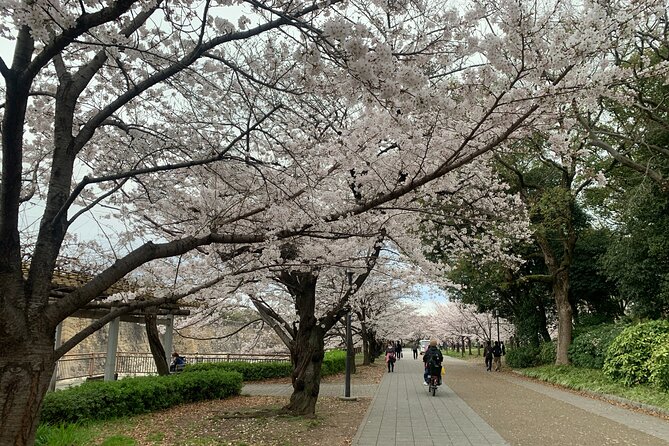
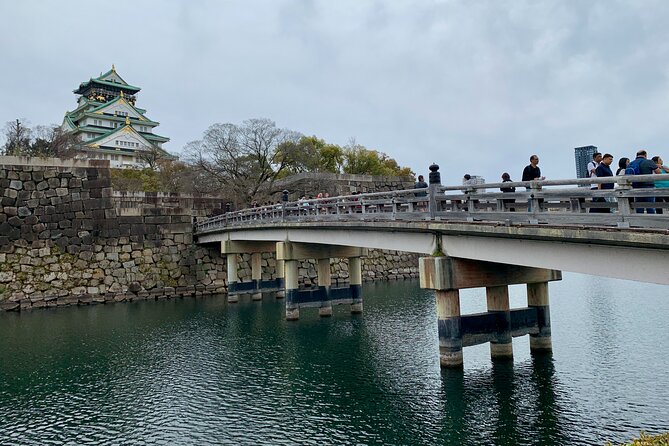
The first major section takes about 1 hour and 20 minutes. You walk toward the main tower through Osaka Castle Park while your guide explains the castle and the city’s past.
Osaka Castle is more than a photogenic tower. It is tied closely to Toyotomi Hideyoshi, the warlord who helped unify Japan in the late 16th century. The castle grounds give your guide room to explain the political importance of Osaka, rather than simply pointing out roofs and stone walls.
The walking approach matters. You get time to see the scale of the park and the castle complex before entering the tower. That gradual arrival is better than stepping directly from a station into a ticket line with no context.
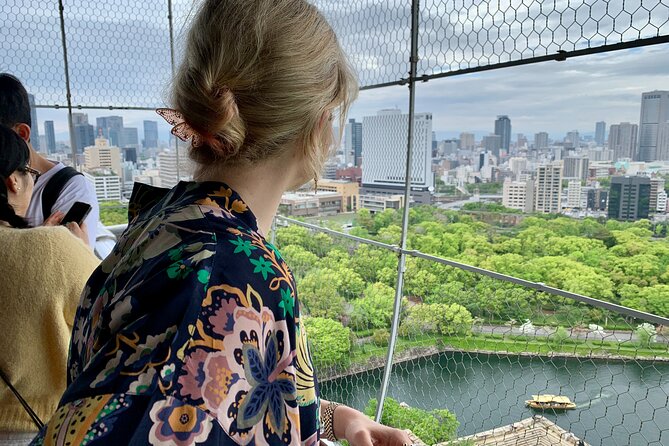
Admission to the main tower is included. Inside, the guide accompanies you, which is helpful if you want historical background as you move through the displays. The upper levels also provide broad city views, a feature that several customers singled out as a highlight.
Expect this stop to combine outdoor walking with indoor sightseeing. In warm or wet weather, the park portion may feel tiring, especially because the rest of the tour also involves city streets and train stations. Wear shoes you can walk in for four hours and bring weather protection.
Hokoku Shrine and the castle park’s quieter corner
Within Osaka Castle Park, the route includes Hokoku Shrine, a small but meaningful stop lasting about 15 minutes.
The shrine is dedicated to Toyotomi Hideyoshi. It was originally built in 1879, and its presence adds another layer to the castle visit. Rather than treating Osaka Castle as a single monument, the guide can show you how the surrounding grounds preserve several parts of the city’s memory.
Fifteen minutes is enough to hear the basic story and look around without turning the tour into a shrine-focused visit. If you enjoy Japanese religious sites, you may wish you had more time here. That is part of the trade-off of a route covering so many districts.
The itinerary also includes Tennoji Park later in the overall journey. The park is near Tennoji Station and includes Tennoji Zoo, the Osaka City Museum of Fine Arts, and Keitakuen Garden, along with the modern Tenshiba area. The supplied schedule does not give a separate time allotment for this stop, so treat it as part of the route rather than a long independent visit.
The short train ride changes the mood completely
After Osaka Castle, you take a train for about 10 minutes to the second sightseeing area. Public transportation is not included, and the stated cost is ¥430 per person.
That extra charge is modest, but it is worth knowing before you book. The train is not a sightseeing ride. Its value is practical: it moves you between districts quickly so the four-hour schedule can include more than one part of Osaka.
This transition also gives the tour a useful rhythm. You start with formal castle grounds, then arrive in a neighborhood with a much more theatrical and old-school feel. Your guide continues the story rather than leaving you to figure out where Shinsekai begins.
More guided walks on foot:
- Deep Backstreet Osaka Tours (Option to add Dinner)
★ 5.0 · 1,290 reviews - Osaka Local Foodie Walking Tour in Dotonbori and Shinsekai
★ 5.0 · 985 reviews - Osaka: Deep Backstreets Walking Tour with Dinner Option
★ 4.9 · 902 reviews - Private Osaka Walking Tour: Highlights & Hidden Gems
★ 5.0 · 569 reviews
Tsutenkaku and Shinsekai’s old Osaka atmosphere
The Tsutenkaku section takes about 50 minutes. From the station, you walk toward the tower while the guide explains the area and its past.
Tsutenkaku is one of Osaka’s best-known symbols. The tower represents a different side of the city from Osaka Castle: less imperial grandeur, more local entertainment and neighborhood character. Its setting in Shinsekai gives you a look at an Osaka that feels playful, loud, and rooted in older popular culture.
The tour does not list entry to Tsutenkaku as included. The stop is focused on walking around the tower and learning about the district, so you should not assume that a tower admission ticket is part of the price.
This is a good place to ask your guide about local customs and food. Shinsekai is famous for kushikatsu, a style of deep-fried skewered food, though the tour does not include a meal or food tasting. You will have opportunities to see food shops and decide what to try later.
Janjan Yokocho and the pleasure of a side street
The route includes Janjan Yokocho, a lively alley in Shinsekai with a retro look, local food, and a strong neighborhood identity. The name comes from the sound of shamisen music once associated with the lane.
This is the kind of stop that makes a guided walk more useful than a list of famous towers. A guide can explain why the alley feels different from newer shopping areas and point out details you might pass without noticing.
You should keep your expectations realistic. Janjan Yokocho is a short street-level visit, not a dedicated food tour. You may see tempting dishes, but the tour price does not cover food or drinks. If you want to eat, ask the guide for advice and allow time after the official route.
The walking surface and crowded areas also make comfortable shoes important. You need only moderate physical fitness, but you will be on your feet for much of the experience.
A stone-paved lane and Hozenji Temple
The tour later moves through a beautiful stone-paved alley preserved from the Edo period. This change of setting is one of the route’s nicest details. After the open spaces around the castle and the broad streets of Shinsekai, the narrow lane offers a more intimate view of Osaka.
Hozenji Temple is a 15-minute stop. Its main attraction is the moss-covered Mizukake Fudo, a statue of Fudo Myoo, also known as Acala. Visitors pour water over the statue while making a wish or prayer.
This is a brief visit, but it gives you a chance to take part in a simple local practice rather than only looking at buildings. Your guide can explain what you are seeing and how the ritual fits into the temple’s appeal.
Hozenji is also a useful reminder that Dotonbori is not only neon signs and restaurant fronts. Religious spaces and old lanes sit close to Osaka’s busiest entertainment streets. I like that contrast, especially for first-time visitors who might otherwise see only the commercial side of Namba.
Dotonbori and Ura-Namba, finishing where Osaka gets loud
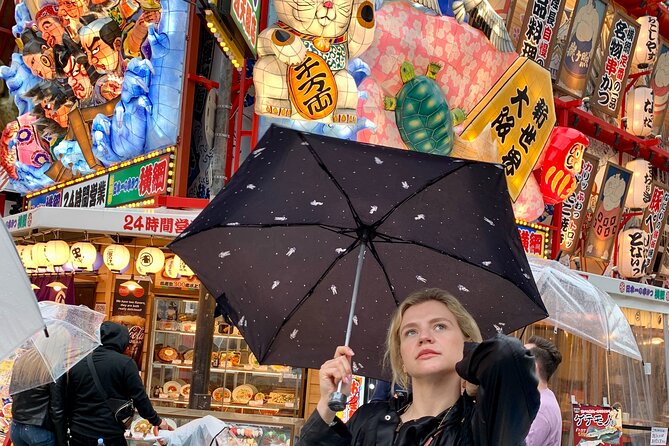
The final section lasts about 1 hour and 10 minutes. You walk through Dotonbori while the guide explains its history, then take a detour through Ura-Namba and visit a temple.
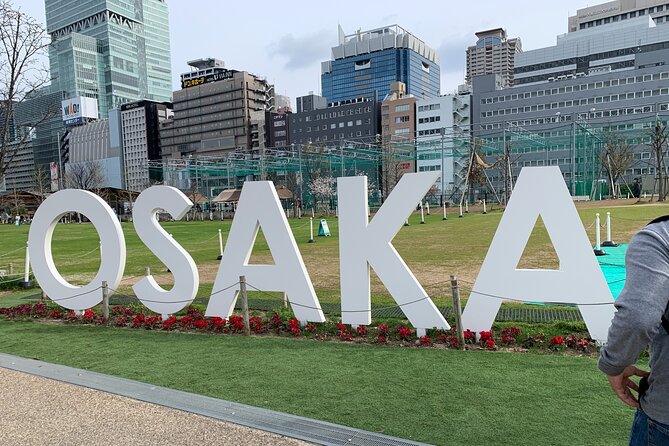
Dotonbori is the tour’s most energetic stop. The district is known for food, entertainment, bright signs, and the canal-side area around Ebisu Bridge. Ending here makes sense because you can continue exploring after the guide leaves.
The Ura-Namba detour adds value. It takes you away from the most obvious main street and into smaller lanes where restaurants and local businesses give the area a more everyday feel. The route does not promise a meal, but it puts you in a good position to choose one.
I would save your appetite for this part of the day. You can taste iconic Osaka street food or plan a proper meal after the tour, but food purchases are your responsibility. A guide who knows the neighborhood can also help you understand the difference between a famous photo stop and a place worth lingering over.
The tour ends at Ebisu Bridge in Dotonbori. This is convenient if you want to continue into the evening, but less convenient if you need to return to the starting point immediately. You will need to arrange your own way back.
What the guides add to the experience
The strongest part of this tour is the guide-led explanation. Several guides have been praised by name, including Aki, Tatsuya, and Yuya. Yuya was noted for strong English and experience living in the United Kingdom, while Tatsuya was praised for patience and kindness. Aki was remembered for high energy and clear explanations.
Of course, the individual guide you receive may vary. Still, the pattern is useful: this experience depends heavily on having someone who can connect the sights and answer questions without making the walk feel like a lecture.
That matters at Osaka Castle, where the buildings alone do not explain the city’s past. It matters again in Shinsekai, where the neighborhood’s character is easy to enjoy but harder to understand without context. In Dotonbori, a guide can point you toward less obvious lanes instead of leaving you with the main tourist strip.
The maximum group size is 12 people. That is small enough for a guide to hear questions and keep the group together, though the experience will not feel private. If you want a completely personal schedule, a private tour would be a better fit, but this group format keeps the price more approachable.
Is $62.05 a fair price?
At $62.05 per person, the price is reasonable for a four-hour guided walk that includes Osaka Castle’s main tower admission and covers several widely separated districts.
The value is not just the entry ticket. You are also paying for route planning, local transportation guidance, historical explanation, and the time saved by moving directly from one area to the next. If you tried to build the same introduction yourself, you would need to research the sights, work out the train connections, and decide how much time to spend in each neighborhood.
The ¥430 transportation cost is extra, and food is not included. You should also budget for any optional admission you choose at Tsutenkaku, since that stop is listed as free and the tour does not include tower entry.
I see this as a good value for a short Osaka visit, especially if you have one day or less in the city. If you already know Osaka well, or prefer to spend half a day inside Osaka Castle alone, the broad route may feel too compressed.
Who will enjoy this four-hour walk?
I would choose this tour if you want a clear introduction to Osaka and prefer having a local person handle the route.
It suits:
- First-time visitors with limited time
- People who want history mixed with food districts and neighborhood walks
- Solo visitors who prefer a small group
- Visitors who want to ask questions in English
- Anyone who likes ending near restaurants and nightlife
It may be less suitable if you dislike walking, want long visits at each attraction, or need a fully flexible schedule. The tour asks you to keep moving, and the route includes trains, city streets, parks, lanes, and station areas.
The experience requires a moderate level of physical fitness. Light rain does not necessarily ruin the day, but the tour requires good weather and may be canceled if conditions are poor. If that happens, you are offered another date or a full refund.
Free cancellation is available if you cancel at least 24 hours before the start time. Inside that window, the amount paid is not refunded, and changes are not accepted.
Should you book Osaka Highlights?
Book it if you want to see Osaka Castle, Tsutenkaku, Hozenji Temple, and Dotonbori in one well-planned morning or afternoon. The best reason to choose it is the combination of wide coverage and local explanation. You get the major first-visit sights, but also stone lanes, a shrine, Ura-Namba, and the food streets between them.
The main caution is pace. Four hours is enough for a strong introduction, not a slow study of every stop. You will also pay separately for transportation and anything you eat or enter beyond the included castle admission.
For a first day in Osaka, a short visit, or a quick orientation before exploring on your own, I would book this tour. If you have several days and enjoy setting your own pace, use the route as a guide to places you can later revisit slowly.
FAQ
How long is the Osaka Highlights walking tour?
The tour lasts approximately four hours.
Where does the tour start?
It starts at the 7-Eleven Osaka Tanimachi 3-chome, located at 3-chome-1-17 Tanimachi, Chuo Ward, Osaka.
Where does the tour end?
The tour ends at Dotonbori, at Ebisu Bridge.
Is Osaka Castle admission included?
Yes. The admission fee to Osaka Castle’s main tower is included.
Is public transportation included in the price?
No. Public transportation costs ¥430 per person and is paid separately.
How many people can join the tour?
The tour has a maximum of 12 travelers.
What happens if bad weather cancels the tour?
The experience requires good weather. If it is canceled because of poor weather, you are offered a different date or a full refund.
Just added around Osaka
- Nara Day Trip from Osaka with a Licensed Guide★ 5.0 · 3 reviews
- Osaka Early Morning Osaka Castle Tour Avoid Crowds★ 5.0 · 3 reviews
- Guided Tour of Some Attractions in Osaka by Private Car★ 5.0 · 3 reviews
- Shared Arrival Transfer: Osaka Itami Airport to Osaka City★ 5.0 · 3 reviews
- Private Transfer Between Kyoto and Kansai Airport KIX★ 5.0 · 3 reviews
- Osaka: Sushi Making Class and Dotonbori Food Tour★ 4.7 · 3 reviews
- Osaka Night Photography Workshop★ 5.0 · 3 reviews
- Kyoto Full day Tour Kinkakuji, Kiyomizu-dera and Fushimi Inari★ 4.5 · 3 reviews
Osaka Highlights & Hidden Gems Tours, compared.
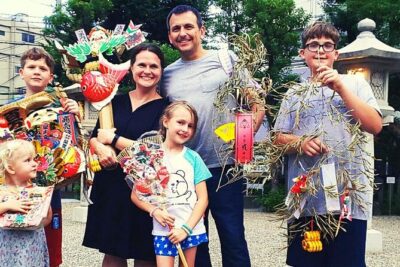

Ultimate Osaka Walking Tour: Castle, Dotonbori & Hidden Gems
Read our review →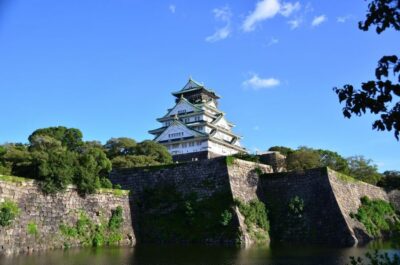
Main Sights and Hidden Spots Guided Walking Tour
Read our review →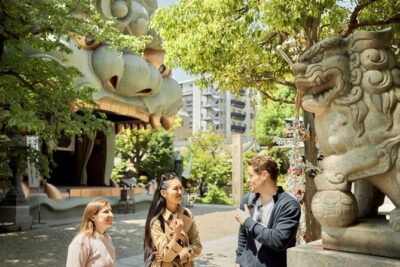
Private Osaka Walking Tour: Highlights & Hidden Gems
Read our review →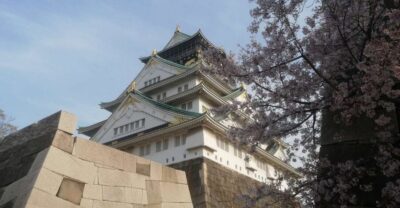
Five Must-See Highlights Walking Tour & Ramen Lunch
Read our review →
Ancient Capital Tour: Kyoto and Nara Highlights from Kyoto/Osaka
Read our review →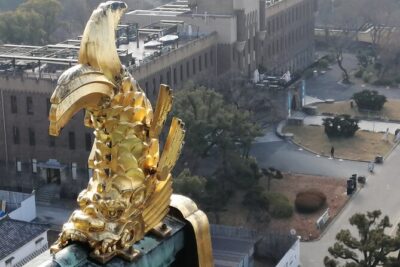
Walking Tour of Osaka’s 5 Must-See Sights, with Ramen for Lunch
Read our review →
Osaka Highlights: 4-Hour Walking Tour with Castle
Read our review →Browse the lists this tour appears in