
Reviewed · OSAKA CASTLE TOURS
Osaka Castle & Dotonbori Lively One-Day Walking Tour
Osaka’s past and present come together neatly on this seven-hour walking tour. You move from an ancient palace site and samurai-era castle to old shopping streets, a recreated 19th-century neighborhood, Kuromon Market, and the neon-lined Dotonbori canal. It is a full day, but it gives you a useful first look at several very different sides of the city.
I like the small maximum of five people, which gives your guide room to answer questions and adjust the pace. I also like that the tour uses Osaka’s public transportation rather than keeping you behind a vehicle. The tradeoff is clear: you will walk a lot, and one earlier participant expected a car tour, so bring comfortable shoes and prepare for stairs, stations, and weather.
In This Review
- Key things to know before you book
- A smart first day in Osaka
- Seeing Osaka from the Museum of History
- Osaka Castle and the samurai story
- Tenjinbashisuji, Osaka’s everyday shopping street
- Old Osaka rebuilt at the Housing and Living Museum
- Kuromon Market and Osaka’s food culture
- Dotonbori after the markets
- Why the small group changes the day
- Walking, trains, and the practical side
- Who will get the most from this tour
- Should you book the Osaka Castle and Dotonbori tour?
- FAQ
- How long does the Osaka Castle and Dotonbori tour last?
- What time does the tour start?
- Where does the tour begin?
- How many people can join the tour?
- Is this a walking tour or a vehicle tour?
- Are admission fees included?
- Is food included in the price?
- Does the tour include Osaka Castle?
- Do I need good physical fitness?
- What happens if bad weather cancels the tour?
Key things to know before you book
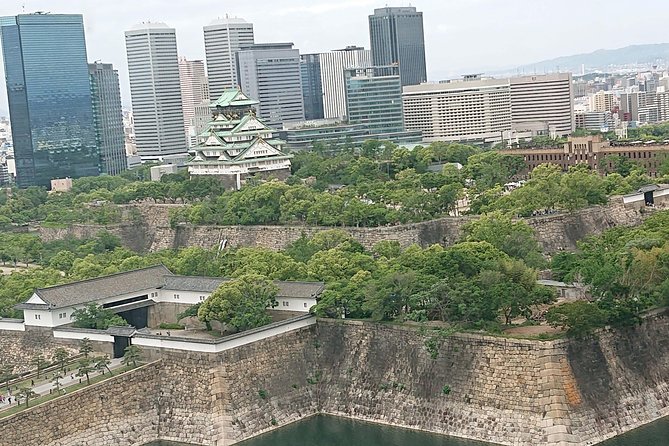
- Osaka Castle gets proper time: You spend about 90 minutes at the castle, with admission included.
- The 10th-floor museum view matters: The Osaka Museum of History offers an excellent look toward the castle before you visit it.
- Japan’s longest shopping arcade is on the route: Tenjinbashisuji stretches about 2.6 kilometers and contains roughly 600 shops.
- The group stays very small: No more than five people are accepted, making questions and pace changes easier.
- Food is not included: You visit Kuromon Market, but you pay separately for anything you eat or drink.
- This is a walking and subway day: Public transportation costs are included, but a moderate level of fitness is needed.
A smart first day in Osaka
At $141.23 per person, this is not a bargain-priced orientation walk. It is a full-day guided outing that bundles admission to three paid sights, public transportation, hotel pickup as advertised, and the services of a professional guide.
That price makes more sense if you value structure. Osaka is easy to enjoy, but its sights are spread across different districts. On your own, you would need to plan train routes, buy tickets, find museum entrances, manage the castle visit, and decide where to stop in Tenjinbashisuji and Dotonbori. Here, the day is arranged for you.
The tour is also useful if you have only one day in Osaka. It does not try to show every major attraction. Instead, it links historical Osaka, everyday shopping, local food culture, and the city’s best-known entertainment district. You get a broad introduction rather than a slow, specialist visit to one neighborhood.
The main limit is time. An hour at the history museum and 90 minutes at Osaka Castle allow a good overview, but not a detailed study of every exhibit. The 30-minute visits to Kuromon Market and Dotonbori are short, too. I see this as a sampler with a guide, not a replacement for returning to your favorite area later.
More of Dotonbori and Namba after dark:
- Osaka Local Foodie Walking Tour in Dotonbori and Shinsekai
★ 5.0 · 985 reviews - Osaka: Dotonbori District River Cruise with Drink Discount
★ 4.2 · 876 reviews - Ultimate Osaka Walking Tour: Castle, Dotonbori & Hidden Gems
★ 5.0 · 862 reviews
Seeing Osaka from the Museum of History
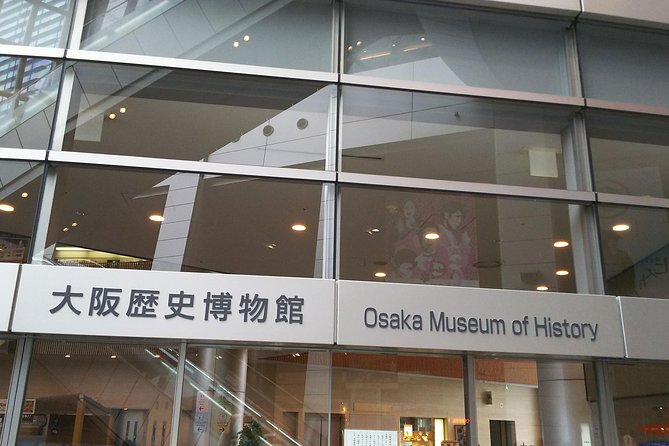
The day begins at the Osaka Museum of History, located in front of Osaka Castle and built on the site of an ancient palace. The location gives the museum immediate value: before you even reach the castle grounds, you are looking at the place where Osaka’s political past began.
You spend about an hour here, and admission is included. One of the best features is the view from the 10th floor, where you can look toward Osaka Castle. That high viewpoint helps you understand the castle’s position in the city instead of meeting it as an isolated building.
The museum provides a useful setting for the rest of the day. You start with Osaka’s older story, then see how the castle shaped the city, and later move into the streets and markets where ordinary life took place. Your guide can connect these stops in a way that is harder to do with a quick visit on your own.
Keep your expectations sensible. This is not a museum-only tour, so you will not have hours to read every display. If your main interest is detailed Japanese archaeology or palace history, you may want extra time here on another day.
Osaka Castle and the samurai story
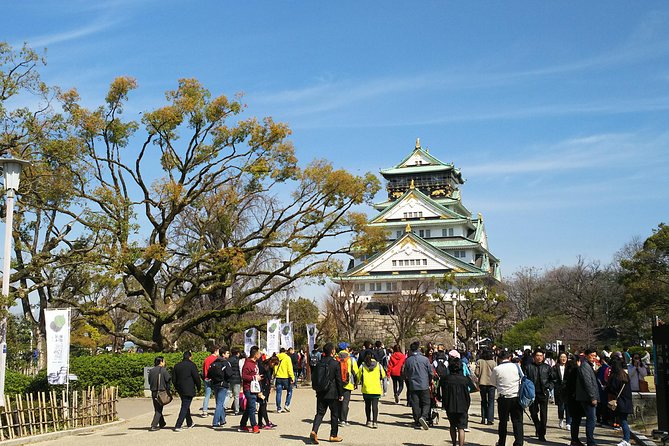
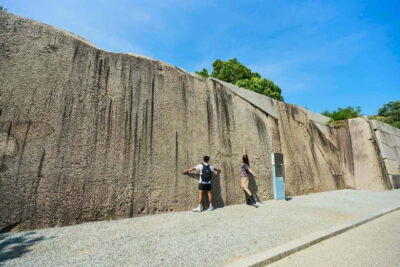
Osaka Castle receives the longest single visit, about 90 minutes. Admission is included, and the tour gives you enough time to appreciate the huge stone walls, moats, turrets, and castle grounds without reducing the stop to a quick photograph.
The castle was built in the 17th century under the Tokugawa Shogunate and was associated with Toyotomi leadership. Its defensive design is the point: broad moats, tall stone walls, and fortified towers show the military power that once controlled this part of Japan.
I like having a guide here because the castle is visually impressive but easy to experience as a series of walls and views. A guide can explain what you are seeing and answer questions as you move through the grounds and interior. Mizuho, Satomi, and other guides have been praised for giving especially useful explanations at the castle.
You may also benefit from the tour’s organized entry. One participant specifically appreciated being able to go directly into the castle rather than losing time arranging the visit. That does not mean there will never be a wait, but having admission handled as part of the day reduces one common bit of friction.
The castle is a major Osaka sight, so it can feel more crowded and polished than the older neighborhoods later in the tour. It is still worth your time, especially because the museum and castle work well together. Just remember that castle visits involve walking, and this is only the first major section of a much longer day.
Tenjinbashisuji, Osaka’s everyday shopping street
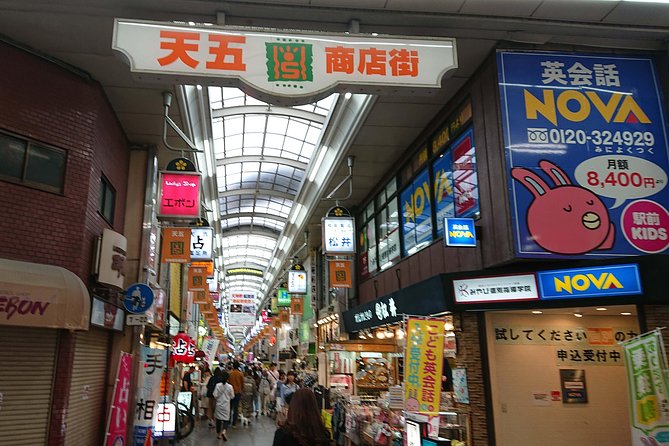
After the castle, the tour shifts from grand history to daily life at Tenjinbashisuji Shopping Street. At about 2.6 kilometers, it is described as Japan’s longest shopping arcade, with around 600 shops.
You spend roughly an hour here. That is enough to get a taste of the street, but not enough to walk its full length at a relaxed pace. The value lies in seeing a place used by local residents, with shops and food stops arranged along a covered arcade.
This is one of the tour’s more authentic-feeling sections because it is not only a sightseeing site. You can browse stores, watch the steady flow of local shoppers, and see how Osaka’s retail districts work. The covered arcade is also helpful if the weather turns uncertain, although you still need to walk between some stops and through outdoor areas during the day.
I would not expect a formal shopping session. The guide is balancing several stops, so you may have time to look around rather than make a long purchase list. If you want to explore all 2.6 kilometers, return independently after the tour.
More tours of Osaka Castle and its grounds:
- Osaka Castle: Museum and Tower Entry Ticket
★ 4.5 · 2,380 reviews - Osaka Castle Walking Tour and Castle Tower Admission
★ 5.0 · 561 reviews - 5-Hour Osaka Bike Tour to the Neighborhood of Osaka Castle
★ 5.0 · 319 reviews - Osaka Castle Guided Tour
★ 4.7 · 249 reviews
Old Osaka rebuilt at the Housing and Living Museum
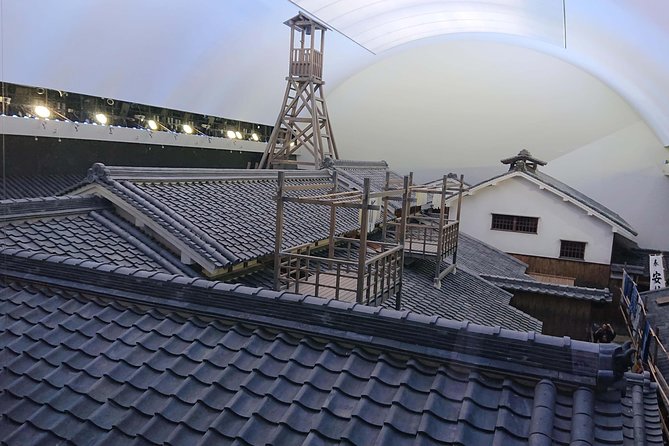
The Osaka Museum of Housing and Living offers one of the day’s most distinctive stops. A full-size townscape from about 180 years ago has been recreated inside, allowing you to walk through old Osaka rather than viewing the period only through photographs or isolated objects.
The visit lasts about 40 minutes, with admission included. You can see the structure of the houses and the kinds of goods sold at the time. The museum is designed around direct experience, so it gives you a clearer sense of scale and street life than a standard display of artifacts.
This stop adds balance to Osaka Castle. The castle shows power, defense, and national events. The housing museum focuses on homes, shops, and the shape of an ordinary neighborhood. I value that contrast because it keeps the day from becoming a string of famous monuments.
Forty minutes is enough for an introduction, but it is not generous if you read every explanation. Your guide’s comments can help you notice details quickly. Families and visitors who enjoy reconstructed historic settings may find this more engaging than a traditional museum, while serious students of urban history may want to return for longer.
Kuromon Market and Osaka’s food culture
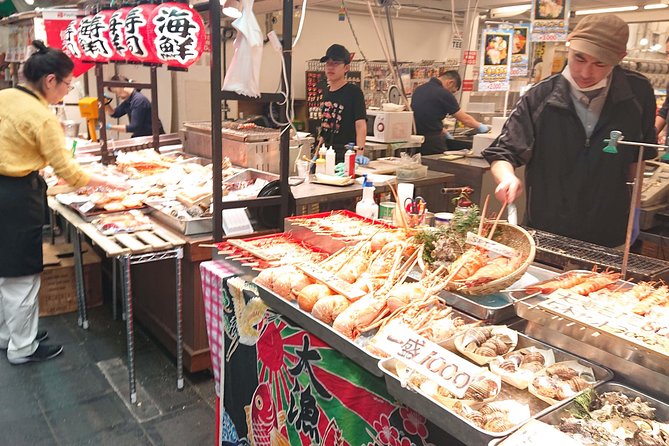
Kuromon Market is the food stop, though it is not a meal stop included in the price. You spend about 30 minutes walking through the market, where many food sellers operate close together.
Osaka is often called Japan’s Food Capital, and Kuromon gives you a quick look at why food is central to the city’s identity. The market is colorful and useful for seeing ingredients, prepared foods, and the way Osaka’s shopping culture connects with eating.
You should budget extra money if you want to sample something. Food and drinks are not included, and 30 minutes can disappear quickly if you stop to browse. The guide may help you understand what you are seeing or point out suitable options, but the supplied details do not promise a specific tasting menu or lunch arrangement.
Some guides have helped visitors find reasonably priced places to eat, and Toshi was specifically praised for arranging a good-value lunch. Treat that as a benefit of having a flexible guide, not as a guaranteed included meal. If lunch matters to you, ask your guide about timing and cost during the day.
Dotonbori after the markets
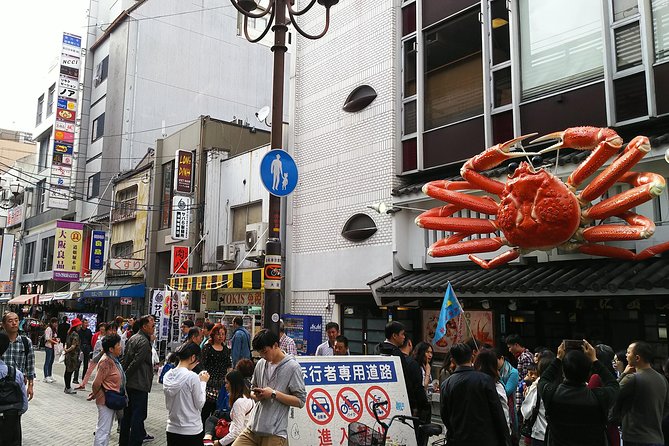
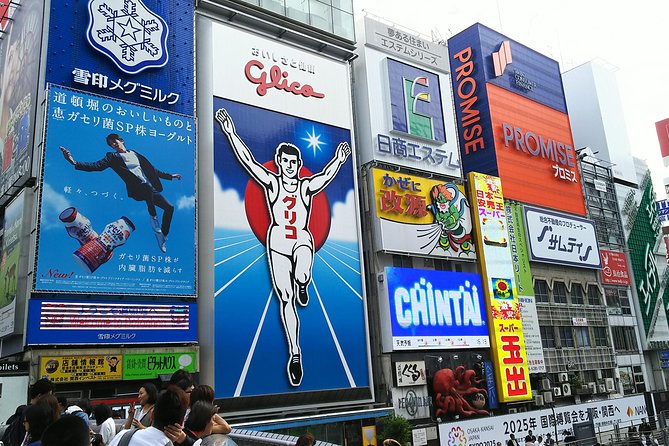
The final sightseeing stop is Dotonbori, Osaka’s famous entertainment district along the canal. You spend about 30 minutes here, seeing the colorful restaurant signs and the area that now draws large numbers of visitors.
Dotonbori was once known locally as an entertainment zone lined with theaters. Its present character is more food, lights, signs, and nightlife. It is a sharp change from the quiet historical displays earlier in the day, and it gives you a feel for Osaka’s playful public personality.
Thirty minutes is enough for orientation and photographs, but not for a full evening. I recommend treating this stop as a preview. After the tour ends, you can return for dinner or a longer walk if Dotonbori interests you.
The area is popular, so do not expect the same calm pace you may have had in the museums. Your guide can help you understand where you are and how the district fits into Osaka’s past, but the stop is short and primarily atmospheric.
Why the small group changes the day
With a maximum of five people, this tour is much more personal than a large coach excursion. Guides including Chuji, Tomoko, Noriko, Taka Sakai, Yoko, Leo, Mizuho, Saori, and Satomi have been praised for clear explanations, patience, organization, and willingness to answer questions.
The guide quality is central to the experience. Tomoko has been described as easy to understand and well organized. Noriko has helped with hotel pickup and subway travel. Taka Sakai has been appreciated for his humor and relaxed conversation, while Saori adjusted the pace for a three-generation family.
Those details matter because this is not simply a route between attractions. You spend much of the day walking and using public transportation, so a guide who listens can make the schedule feel manageable. Several participants appreciated not being rushed, and that is especially important when weather or family needs affect the pace.
A small group does not guarantee a private tour. The stated limit is five people, and the actual group size can vary. Still, this format gives you a better chance to ask about Osaka’s subway system, food, neighborhoods, or the sights that catch your eye.
Walking, trains, and the practical side
The tour lasts about seven hours and begins at 9:00 a.m. The listed meeting point is Osaka Station, at 3-chōme-1-1 Umeda, Kita Ward, Osaka. The tour description also advertises pickup from your Osaka hotel, so confirm the exact pickup arrangement when you book, especially if you are relying on hotel pickup.
The tour uses public transportation and walking. That is a plus if you want to learn how Osaka works, rather than seeing the city only through a vehicle window. Public transportation costs are included, and one guide helped a participant understand the subway system, a useful skill for the rest of your stay.
It is also the main physical demand. Wear comfortable walking shoes. A prior participant specifically warned against choosing boots, and another person said the walking format was unexpected after assuming a vehicle would be used. The operator’s guidance calls for moderate physical fitness.
Rain can affect the schedule because the experience requires good weather. If poor weather causes cancellation, you are offered another date or a full refund. You can also cancel for a full refund up to 24 hours before the start time. Those rules are worth noting if your Osaka schedule is tight.
Who will get the most from this tour
I would choose this outing if you are visiting Osaka for the first time and want a guided introduction that mixes major sights with ordinary streets. It is particularly useful if you like history but also want markets, shopping arcades, and nightlife areas in the same day.
It suits solo visitors and couples who value conversation, as well as families that want help with trains and timing. The small group and flexible guides can be helpful for a mixed-age family, although every person should be ready for a long day on foot.
You may want another plan if you dislike public transportation, need a slow schedule, or want to spend a full day at Osaka Castle alone. The tour covers many districts, so it favors variety over lingering. It is also not the right choice if you expect lunch, tastings, or shopping purchases to be part of the $141.23 price.
Should you book the Osaka Castle and Dotonbori tour?
Book it if you want an organized first day with a human guide, included admissions, and a group capped at five. The strongest parts are the museum-to-castle sequence, the glimpse of daily life at Tenjinbashisuji, and the chance to connect the subway, markets, and Dotonbori in one route.
I would book with comfortable shoes, a flexible attitude, and a separate food budget. Confirm hotel pickup versus the Osaka Station meeting point, and do not mistake the 30-minute market and Dotonbori visits for full meals or extended exploration.
At $141.23, the value comes from saving planning time and getting personal guidance across a wide slice of Osaka. If that is worth more to you than exploring independently, this is a strong choice for a one-day introduction.
FAQ
How long does the Osaka Castle and Dotonbori tour last?
The experience lasts approximately seven hours.
What time does the tour start?
The stated start time is 9:00 a.m.
Where does the tour begin?
The listed meeting point is Osaka Station, at 3-chōme-1-1 Umeda, Kita Ward, Osaka, 530-0001, Japan. The tour description also mentions pickup from your Osaka hotel, so confirm the exact arrangement before the day.
How many people can join the tour?
The tour has a maximum of five participants.
Is this a walking tour or a vehicle tour?
It is a walking tour that also uses public transportation. Public transportation costs are included.
Are admission fees included?
Yes. Admission to the Osaka Museum of History, Osaka Castle, and the Osaka Museum of Housing and Living is included.
Is food included in the price?
No. Food and drinks are not included. You visit Kuromon Market, but you pay separately for anything you purchase.
Does the tour include Osaka Castle?
Yes. Osaka Castle is scheduled for about 90 minutes, and admission is included.
Do I need good physical fitness?
The tour requires a moderate level of physical fitness because it involves substantial walking and public transportation.
What happens if bad weather cancels the tour?
If poor weather causes cancellation, you can choose another date or receive a full refund. You can also cancel at least 24 hours before the start time for a full refund.
More Guided Walks on Foot
- Deep Backstreet Osaka Tours (Option to add Dinner)
★ 5.0 · 1,290 reviews - Osaka: Deep Backstreets Walking Tour with Dinner Option
★ 4.9 · 902 reviews - Osaka: Main Sights and Hidden Spots Guided Walking Tour
★ 4.9 · 702 reviews - Private Osaka Walking Tour: Highlights & Hidden Gems
★ 5.0 · 569 reviews
Just added around Osaka
- Nara Day Trip from Osaka with a Licensed Guide★ 5.0 · 3 reviews
- Osaka Early Morning Osaka Castle Tour Avoid Crowds★ 5.0 · 3 reviews
- Guided Tour of Some Attractions in Osaka by Private Car★ 5.0 · 3 reviews
- Private Transfer Between Kyoto and Kansai Airport KIX★ 5.0 · 3 reviews
- Shared Arrival Transfer: Osaka Itami Airport to Osaka City★ 5.0 · 3 reviews
- Osaka: Sushi Making Class and Dotonbori Food Tour★ 4.7 · 3 reviews
- Osaka Night Photography Workshop★ 5.0 · 3 reviews
- Kyoto Full day Tour Kinkakuji, Kiyomizu-dera and Fushimi Inari★ 4.5 · 3 reviews
Osaka Castle Tours, compared.
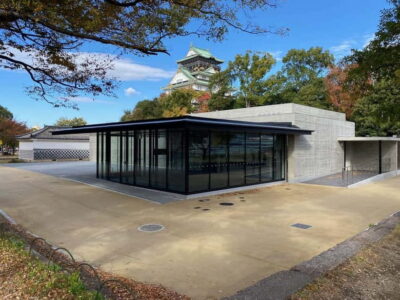
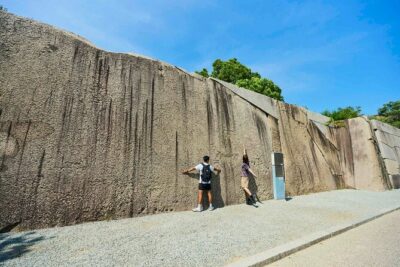
Osaka Castle Walking Tour and Castle Tower Admission
Read our review →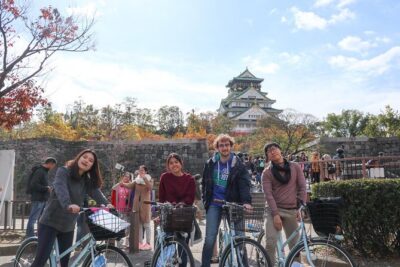
5-Hour Osaka Bike Tour to the Neighborhood of Osaka Castle
Read our review →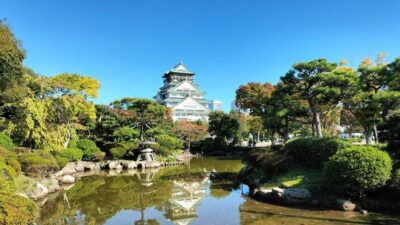
Castle History Walking Tour / Castle Tower Admission
Read our review →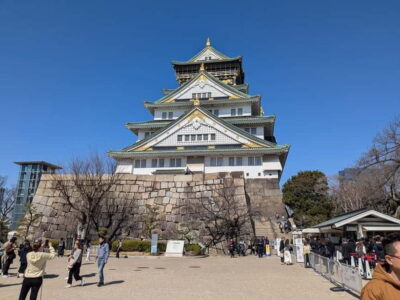

PRIVATE 6hr, Food tour from Osaka Castle, Kuromon, Dotonbori.
Read our review →
A Tour to Explore the Symbol of Osaka: Osaka Castle
Read our review →Browse the lists this tour appears in