
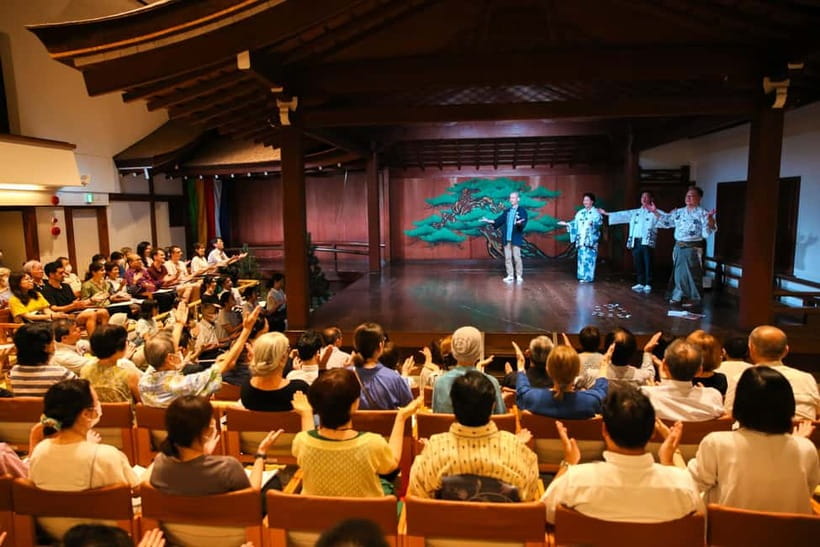
Reviewed · OSAKA SUMO & TRADITIONAL SHOWS
Osaka: Noh Performance with English Subtitles and Workshop
At Osaka’s Yamamoto Noh Theater, you get more than a seat at a traditional Noh performance. You first receive a plain-language introduction, follow the show with English subtitles, then handle masks, costumes, and instruments after the curtain falls. It is a smart way to meet one of Japan’s oldest stage arts without needing prior knowledge.
I like the beginner-friendly setup and the theater’s character: this 1927 building is Osaka’s oldest Noh theater and sits in the former samurai residence area near Osaka Castle. I also like the chance to ask questions afterward. One audience member described the theater owner answering more than 10 questions with help from an English translator.
The main drawback is the nature of Noh itself. The roughly one-hour performance can feel slow and restrained if you expect a fast-moving show, and English support is provided through subtitles and interpretation rather than a fully English-language production. Photography and video recording are not allowed inside.
In This Review
- Key points to know before you book
- Why Noh works best as a guided first encounter
- Arriving at Yamamoto Noh Theater near Osaka Castle
- The pre-show explanation makes the difference
- Watching the one-hour Noh performance
- The workshop brings the art down to earth
- What the $32 price gets you
- Who will enjoy this Osaka theater experience
- How to fit the theater into an Osaka day
- Is Yamamoto Noh Theater worth booking?
- FAQ
- How long does the Noh theater experience last?
- Is the Noh performance suitable for people who do not speak Japanese?
- Can I try Noh masks and costumes?
- Can I explore Noh musical instruments?
- Where is Yamamoto Noh Theater located?
- How old is Yamamoto Noh Theater?
- Are children allowed to attend?
- Can I take photos or record video inside?
Key points to know before you book
- A one-hour Noh performance gives you a real taste of the art without taking up a full day.
- English subtitles and a pre-show explanation make the story and stage style easier to follow.
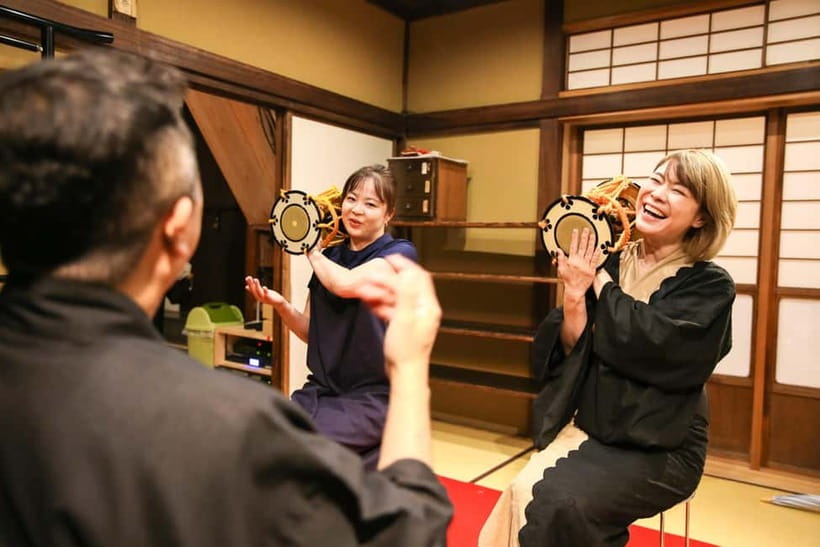
- The workshop comes after the performance, with chances to try masks, costumes, and musical instruments.
- Yamamoto Noh Theater dates to 1927 and is about a 10-minute walk from Osaka Castle.
- The setting is the former samurai residence area, adding historical context before you even take your seat.
- The $32 price is reasonable for a performance, guided introduction, and hands-on workshop in a historic theater.
Why Noh works best as a guided first encounter
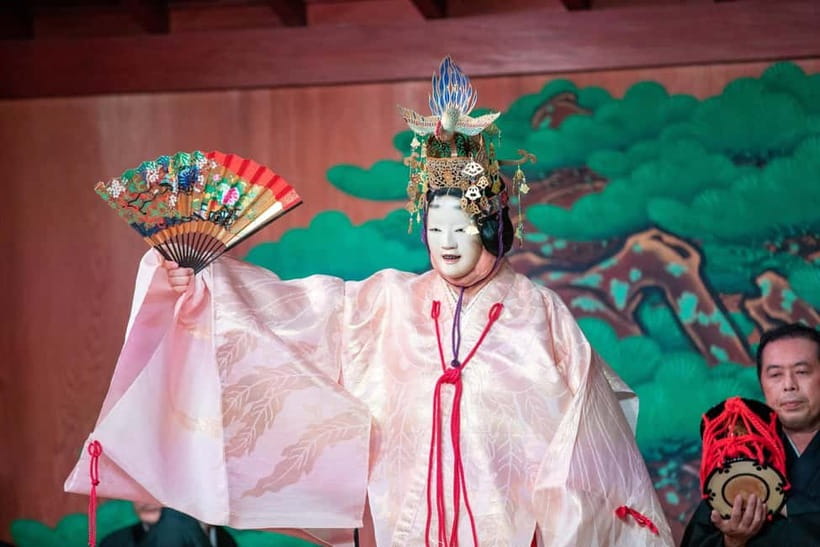
Noh is not the kind of Japanese theater you understand fully by watching from the back of a busy sightseeing schedule. The movements are measured, the music can sound unfamiliar, and the action is shaped by ritual and symbolism rather than rapid plot twists.
That is why the explanation before the show matters. You are given a way to read what you see, listen for the role of the musicians, and understand why a masked performer may move with such care. For a first visit, this short introduction can make the difference between feeling lost and noticing the details.
The English subtitles are another major help. They allow you to follow the story while the performers continue in the traditional Japanese style. This is not a translated stage production, so you still hear the original language and music. You simply have a guide to the meaning.
I would not choose this activity if you want a lively, highly interactive show from the start. The participation comes mainly after the performance. During the play, your job is to watch, listen, and let the slow rhythm settle in.
More traditional craft workshops:
- 1.5〜2 Hours Traditional Kintsugi Work Shop in Namba Osaka
★ 5.0 · 75 reviews - Osaka: Private Japanese Calligraphy Experience
★ 5.0 · 66 reviews - From Osaka: Sakai Knife Maker or Blacksmith Walking Tour
★ 4.9 · 64 reviews
Arriving at Yamamoto Noh Theater near Osaka Castle
The theater is in Osaka’s former samurai residence area, about a 10-minute walk from Osaka Castle. That makes it easy to pair with a castle visit, though you should allow enough time to reach the theater without rushing through the historic surroundings.
The location gives the outing a useful sense of place. You are not seeing Noh in an anonymous modern hall. You are entering a theater founded in 1927, the oldest Noh theater in Osaka, and a building registered as Japanese Tangible Heritage in 2006.
Those details do not turn the visit into a museum tour, but they add weight to the performance. The building itself is part of the story. If you have already spent time around Osaka Castle, the theater makes a natural second stop in an area tied to Japan’s samurai past.
The walk from the castle is short, but Osaka can be busy and streets around major sights are not always intuitive. Check the starting time when booking and plan to arrive with a little breathing room. The activity lasts two hours, so a late start could affect both the explanation and the performance.
The pre-show explanation makes the difference
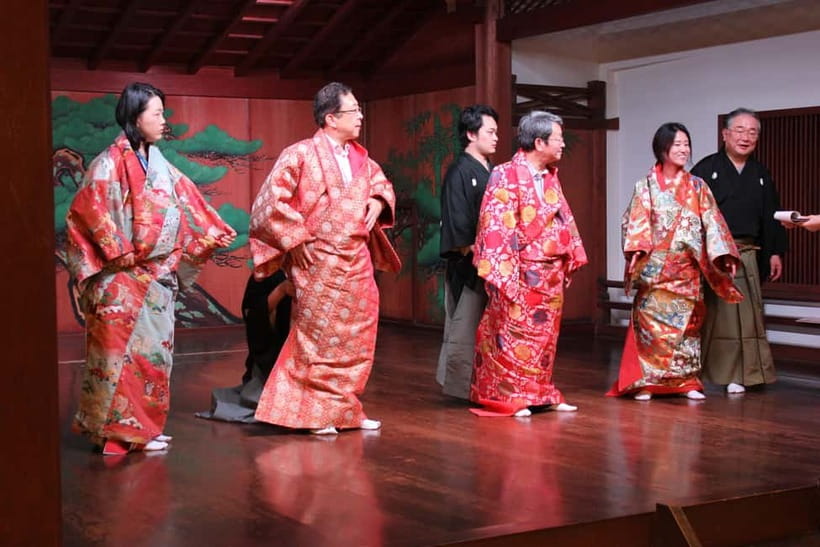
The activity begins with an explanation designed for people who may know very little about Noh. This is one of the strongest parts of the format because it gives you a frame for the performance before you see it.
You can expect help in English or Japanese, with English support available for non-Japanese speakers. The format is built for beginners, not for specialists who already know the plays, instruments, masks, and stage conventions.
Pay attention to the explanation of the masks and costumes. Their appearance is not simply decorative. Once you see them again in the workshop, you have a better sense of how much meaning can be carried by a small change in posture, a face turned toward the light, or the slow movement of a costume.
The introduction also prepares you for the sound. Noh uses musicians and vocal performance in a way that may not resemble Western theater. The music can feel spare, sharp, or repetitive at first. With a little guidance, you can listen for how sound supports the movement rather than expecting a familiar melody or orchestral score.
Watching the one-hour Noh performance
The performance lasts about one hour within the two-hour activity. That is long enough to see the form develop, but short enough for a first encounter to remain manageable.
Noh asks for patience. The action is formal and controlled, and the pace may seem unusually quiet if your usual theater choices are musicals, historical spectacles, or comedy shows. I suggest treating it less like a plot-driven play and more like a carefully arranged meeting of movement, costume, voice, and music.
The English subtitles let you follow the basic meaning without turning the show into a language lesson. They are especially useful when the performance becomes symbolic or when the words are delivered in a traditional style that can be difficult even for some Japanese audiences.
You may still miss details. The English support does not mean every cultural reference or poetic shade will be explained in full. That is normal for an art form with centuries of tradition. The goal is to give you a clear path through the performance, not to provide a line-by-line academic study.
The setting also affects the experience. A historic Noh theater feels more intimate than a large modern venue. You are close to the stage world, but you also need to respect the quiet atmosphere. Do not plan on taking pictures during the show. Photography and video recording inside are not allowed.
More sumo, taiko and stage shows:
- Osaka: Sumo Show & Experience w/ Optional Kimono & Hot Pot
★ 4.5 · 609 reviews - Osaka: Sumo Stage Show with Bento or Snack + Fight & Photo
★ 4.3 · 364 reviews - Osaka: English Stand Up Comedy Show at Osaka Comedy Club
★ 4.7 · 203 reviews - Osaka: UTAGE Japanese Taiko Live Show
★ 4.9 · 167 reviews
The workshop brings the art down to earth
After the performance, the activity becomes more hands-on. You can try Noh masks and costumes, and you can explore the musical instruments used in the performance.
This is where the experience becomes especially useful for families with older children, culture-focused visitors, and anyone who found the show difficult to read at first. You can look closely at objects that seemed distant during the performance. A mask is no longer just a face on stage. A costume is no longer just a block of color moving slowly through the scene.
The workshop also gives you a chance to ask questions. English and Japanese are supported, and an English translator may help with communication. One especially useful part of the format is the question period after the performance. The theater owner has answered more than 10 audience questions, which suggests you should think of a few things to ask before you arrive.
You might ask how the instruments work, why performers use masks, or how the theater preserves Noh for modern audiences. The information provided does not promise that every instrument will be demonstrated in detail, so keep your expectations practical. You are getting an introduction and a chance to handle or explore selected items, not a full music lesson.
A Spanish-speaking participant specifically wished for information in more languages and a closer look at instruments beyond the drum. That is useful advice. English is the main language support for international visitors, while other languages are not guaranteed. If you want to understand every musical element, the workshop may leave you wanting more.
What the $32 price gets you
At $32 per person, this is a fair price for a two-hour cultural activity in central Osaka. You are paying for a live Noh performance, an explanation before the show, English subtitles, and a workshop with masks, costumes, and instruments.
The value is strongest if you would not otherwise seek out Noh on your own. Buying a ticket to a traditional performance without context can be a gamble. Here, the explanation and subtitles reduce that risk, and the workshop gives you a second way to connect with what you have seen.
The price is less compelling if you only want a quick photo opportunity or a short cultural demonstration. The main performance takes about an hour, and Noh demands quiet attention. You are paying for a real stage art experience, not a rapid activity you can squeeze between shopping stops.
I also like the flexibility of booking now and paying later. You can reserve a place without paying at once, and cancellation is allowed up to 24 hours before the activity for a full refund. That is helpful when your Osaka schedule depends on weather, train plans, or a changing castle itinerary.
Who will enjoy this Osaka theater experience
I would recommend this activity to adults and children aged seven or older who want a serious look at Japanese culture in a manageable format. It suits you especially well if you enjoy traditional arts, historic buildings, or activities that explain what you are seeing instead of simply presenting it.
It is also a strong choice for first-time visitors who worry that Noh will be too difficult. The pre-show talk, English subtitles, and post-show questions give you several ways to follow along.
The experience may suit you less if you need constant movement, bright spectacle, or a fast plot. Young children under seven are not permitted, and older children should be comfortable sitting quietly through a one-hour performance.
English-speaking visitors have the clearest support. The hosts speak English and Japanese, but information in other languages is not promised. If you are traveling with someone who does not understand either language, confirm what assistance will be available before booking.
The theater is wheelchair accessible, which makes it a practical choice for visitors who need an accessible venue. Still, activity details do not specify every feature of the route or seating arrangement, so contact the provider if you require a particular accommodation.
How to fit the theater into an Osaka day
The theater’s position near Osaka Castle is the obvious planning advantage. You can visit the castle area and then walk about 10 minutes to the theater, or schedule the performance first and explore the castle afterward.
Keep the timing realistic. The activity takes two hours, and the performance itself is only one part of that time. The explanation and workshop are not filler. They help you understand the art and give you the hands-on element, so I would not cut either part short.
A castle visit can involve more walking than expected, especially if you explore the surrounding grounds. If your Noh start time is fixed, avoid arriving at the theater after a long detour. The best plan is to treat the performance as the anchor and fit the castle around it.
Remember the theater rules. You cannot photograph or record inside. If you want a souvenir, the masks, costumes, and instruments will need to live in your memory rather than on your phone.
Is Yamamoto Noh Theater worth booking?
Book this experience if you want traditional Japanese theater with enough explanation to make it approachable. The combination of a historic Osaka venue, English subtitles, a one-hour performance, and a practical workshop gives you more than a standard show ticket.
I would especially choose it for a first Noh experience, a culture-heavy Osaka itinerary, or a day built around Osaka Castle. The $32 cost is sensible for the amount of instruction and access included.
Skip it if you need a fast, casual attraction or if a slow performance sounds frustrating. Noh rewards attention, and the English support helps you follow the structure, but it does not change the art into a modern English-language play. Go in expecting restraint, tradition, and a chance to look closely after the curtain closes.
FAQ
How long does the Noh theater experience last?
The activity lasts two hours. The Noh performance itself is about one hour, with an explanation before the show and a workshop afterward.
Is the Noh performance suitable for people who do not speak Japanese?
Yes. English subtitles are provided, and the experience includes an explanation before the performance. Hosts or greeters speak English and Japanese.
Can I try Noh masks and costumes?
Yes. After the performance, you can try Noh masks and costumes as part of the workshop.
Can I explore Noh musical instruments?
Yes. The workshop includes a chance to explore musical instruments used in the performance.
Where is Yamamoto Noh Theater located?
The theater is in Osaka’s former samurai residence area, about a 10-minute walk from Osaka Castle.
How old is Yamamoto Noh Theater?
Yamamoto Noh Theater was established in 1927. It is the oldest Noh theater in Osaka and was registered as Japanese Tangible Heritage in 2006.
Are children allowed to attend?
Children under seven are not permitted. The activity is suitable for children aged seven and older.
Can I take photos or record video inside?
No. Photography and video recording are not allowed inside the theater.
Just added around Osaka
- Nara Day Trip from Osaka with a Licensed Guide★ 5.0 · 3 reviews
- Osaka Early Morning Osaka Castle Tour Avoid Crowds★ 5.0 · 3 reviews
- Guided Tour of Some Attractions in Osaka by Private Car★ 5.0 · 3 reviews
- Shared Arrival Transfer: Osaka Itami Airport to Osaka City★ 5.0 · 3 reviews
- Private Transfer Between Kyoto and Kansai Airport KIX★ 5.0 · 3 reviews
- Osaka: Sushi Making Class and Dotonbori Food Tour★ 4.7 · 3 reviews
- Osaka Night Photography Workshop★ 5.0 · 3 reviews
- Kyoto Full day Tour Kinkakuji, Kiyomizu-dera and Fushimi Inari★ 4.5 · 3 reviews
Osaka Sumo & Traditional Shows, compared.
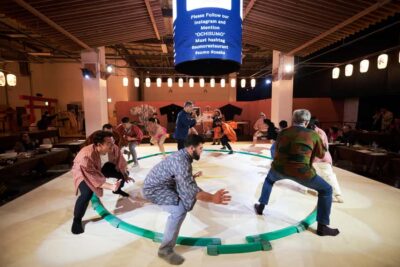
Sumo Show & Experience w/ Optional Kimono & Hot Pot
Read our review →
Sumo Stage Show with Bento or Snack + Fight & Photo
Read our review →
English Stand Up Comedy Show at Osaka Comedy Club
Read our review →
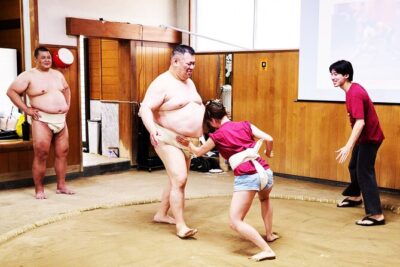
Osaka Sumo Experience with Live Show and Audience Challenge
Read our review →


Osaka Umeda: PICCADILLY DINNER SHOW & NIGHTCLUB with Tasting
Read our review →Browse the lists this tour appears in