
Reviewed · OSAKA COOKING CLASSES
Well-balanced BENTO (lunch box) Cooking Class
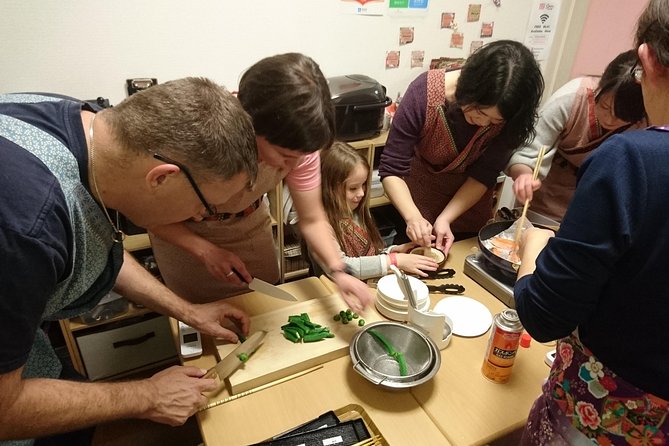
The best part of this Osaka class is that you do not simply watch a chef prepare Japanese food. You make a complete bento lunch, starting with dashi and ending with two triangular rice balls, several side dishes, and miso soup. It is a useful look at the everyday cooking behind restaurant menus.
I like the balance of the meal, which includes Wagyu beef, shrimp, salmon, egg, squash, mushrooms, and green vegetables. I also like the small group, capped at eight people, since instructors such as Yumi and Fumi can give practical help with shaping, seasoning, and packing.
The main consideration is the two-and-a-half-hour schedule. You prepare up to seven dishes, so this is an active class rather than a leisurely lunch. Specific dietary needs must be given when you book, and children need an adult with them.
In This Review
- Key points to know before you book
- Why this bento class is more than a cooking demonstration
- Starting with dashi, the quiet base of Japanese flavor
- Seven home-style dishes, seven different techniques
- Making triangular rice balls with a little help
- Packing the bento is part of the cooking
- Eating your own lunch with miso soup
- The small group makes a real difference
- Is $92.24 a fair price?
- Who will enjoy this Osaka cooking class?
- Timing, meeting point, and booking details
- Should you book the Sakura Cook bento class?
- FAQ
- Where does the bento cooking class take place?
- How long does the activity last?
- What food do you prepare?
- Do I get to eat the food I make?
- Is miso soup included?
- How many people can join the class?
- Can children participate?
- Should I share dietary requirements before booking?
- What is the cancellation policy?
Key points to know before you book
- You make a full seven-dish bento: The menu covers meat, seafood, vegetables, egg, rice, and soup.
- Dashi comes first: You learn about the stock that forms the base of many Japanese dishes.
- Rice-ball shaping is part of the lesson: Plastic molds help you create two neat triangular onigiri.
- Packing is treated as a skill: Fresh vegetables and careful placement make the box look appealing.
- The class stays small: No more than eight people take part, which allows for hands-on guidance.
- The meal is eaten at the end: You finish with chopsticks, miso soup, and the customary itadakimasu.
Why this bento class is more than a cooking demonstration
Many food classes give you one recipe and a taste at the end. This one asks you to build a whole Japanese lunch from its foundation. You make dashi, prepare several ingredients in different ways, arrange the food, and then sit down to eat what you made.
That makes the class especially useful if you want to understand how Japanese home cooking is organized. The focus is not only on flavor. You also learn about variety, portion size, color, texture, and presentation. A good bento should look inviting before you take the first bite.
The menu gives you a broad introduction without becoming a restaurant-style tasting course. Wagyu adds a familiar luxury ingredient, while shrimp and salmon bring seafood to the box. Egg, squash, mushrooms, green vegetables, and rice keep the meal from becoming too heavy.
The class takes place at Sakura Cook in Osaka, at Banix Kitahorie in Nishi Ward. The meeting point is near public transportation, and the activity ends where it begins. That simple arrangement matters in Osaka, where a cooking class can fit neatly into a day of sightseeing without requiring a second location or a long transfer afterward.
More Japanese home cooking classes:
- Osaka: Ramen and Gyoza Cooking Class in Dotonbori
★ 5.0 · 378 reviews - Osaka: Sumo Stage Show with Bento or Snack + Fight & Photo
★ 4.3 · 364 reviews - Osaka: Traditional Mochi Pounding Experience with Tasting
★ 4.9 · 306 reviews
Starting with dashi, the quiet base of Japanese flavor
Cooking begins with dashi, a traditional Japanese broth. This is an important choice because dashi appears in many Japanese dishes, yet it can be easy to overlook when you are eating in restaurants.
Here, you learn the process and the role of the stock before moving on to the rest of the meal. That gives the class a useful cultural layer. You are not just following instructions for a single lunch. You are learning one of the basic building blocks of Japanese cooking.
The dashi lesson is also a good point to pay attention to texture and seasoning. Japanese home cooking often depends on a few carefully handled ingredients rather than a heavy sauce. The broth helps explain why simple dishes can still taste rounded and satisfying.
If you are used to cooking classes that move straight to chopping and frying, this slower beginning may feel different. It uses some of your limited class time, but it gives context to the dishes that follow.
Seven home-style dishes, seven different techniques
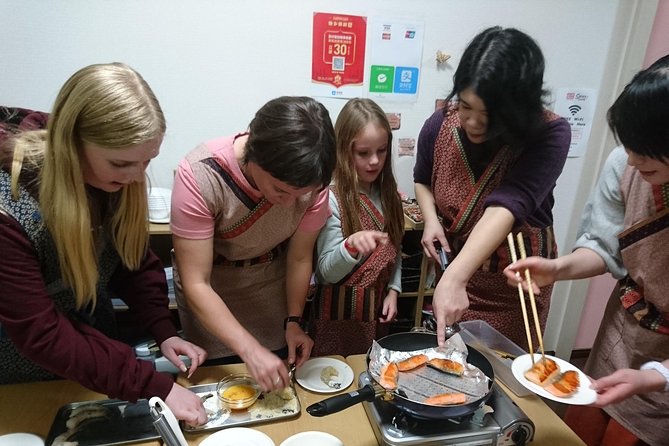
After the broth, you prepare seven basic Japanese dishes often eaten at home. The food includes Wagyu beef, shrimp, salmon, egg, squash, mushrooms, green vegetables, and rice balls.
The useful feature is the range of methods. You practice:
- Frying
- Grilling
- Simmering
- Marinating
- Preparing broth
- Shaping rice
- Packing a bento box
This variety keeps the class active. It also means you leave with more than one technique to repeat at home. A person who already cooks often will still find value in seeing how these methods fit together in one meal.
The Wagyu, shrimp, and salmon provide a mix of rich and delicate flavors. Vegetables and mushrooms give the lunch more balance, while egg and rice make it feel substantial. The class is called well-balanced for a reason: the meal is built around several food groups instead of one large main dish.
Still, you should expect a busy class. Several dishes have to be prepared, cooked, and packed within about 150 minutes. The pace is designed to keep you moving, not to offer long periods of independent experimentation.
The instructors explain each step and guide you through the work. Yumi is described as attentive and clear, with instructions that are easy to follow. Fumi is also noted for careful teaching and detailed explanations. Instructor availability can vary by date, so do not book expecting one specific person unless the provider confirms it.
Making triangular rice balls with a little help
The rice balls are one of the most memorable parts of the session. You practice forming the triangular shape with plastic molds and then complete two rice balls.
That mold is a helpful touch. Hand-shaping onigiri can look simple, but getting a clean triangle takes practice. The mold lets you focus on the basic form without worrying that an imperfect first attempt will fall apart.
You also get a small lesson in the visual side of Japanese food. The rice ball is not simply a lump of rice placed in a box. Its shape contributes to the appearance of the finished lunch.
Families may find this section particularly approachable. A 12-year-old can follow the class with an adult, and the hands-on work gives children a clear task. The rule is that children must be accompanied by an adult, so this is not a drop-off activity.
A few more Osaka tours and experiences worth a look
- Osaka: Five Must-See Highlights Walking Tour & Ramen Lunch
★ 4.7 · 411 reviews - Osaka/Kyoto: Amanohashidate & Miyama Tour with Boat & Lunch
★ 4.6 · 207 reviews - Walking Tour of Osaka’s 5 Must-See Sights, with Ramen for Lunch
★ 5.0 · 158 reviews - 5-Hour Osaka Highlights Bike Tour with Lunch
★ 4.8 · 146 reviews
Packing the bento is part of the cooking
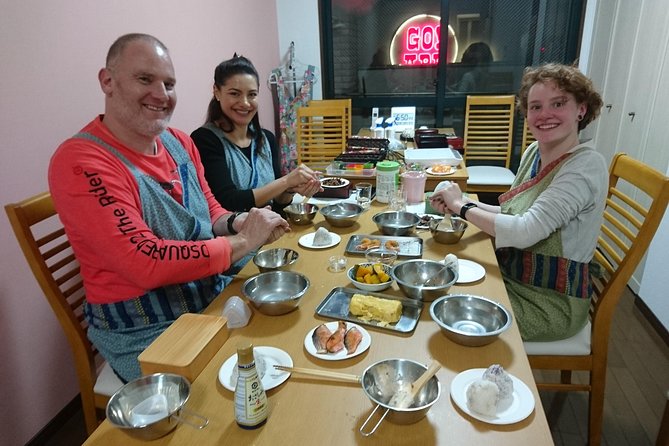
Once the dishes are ready, you choose how to arrange them in your lunch box. Fresh vegetables help fill the spaces and add color. The instructor advises you on an attractive way to pack the food.
This is where the class shifts from cooking to composition. A bento is meant to be pleasing to look at, and the arrangement can make the same ingredients feel more special. You learn to think about color, shape, and the relationship between larger and smaller portions.
At the start, you choose your favorite lunch box and put on an apron. That gives the class a personal feel from the first few minutes. By the end, the container holds food you prepared yourself, arranged according to the principles taught during the lesson.
Do not expect a professional food-styling workshop. The point is practical home cooking. You get useful guidance on making the lunch look neat without needing special equipment or advanced knife skills.
Eating your own lunch with miso soup
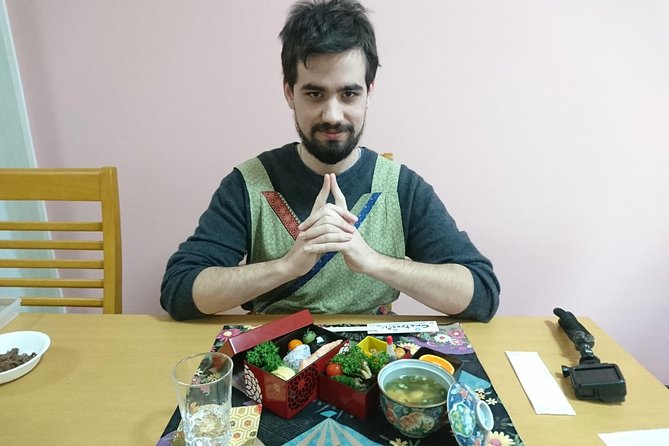
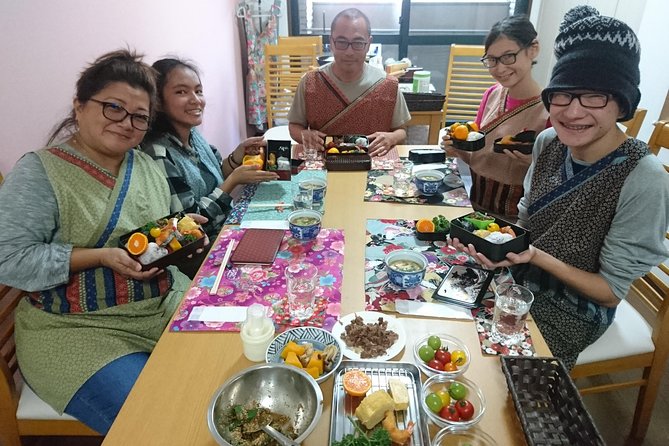
The class ends with the best possible reward: you eat the bento you made. The dishes are placed in the box with chopsticks, and complimentary miso soup completes the meal.
The traditional phrase itadakimasu marks the start of eating. It is a small detail, but it connects the cooking activity with Japanese table customs. You have prepared the ingredients, assembled the meal, and now pause before eating it.
The meal should appeal to people who prefer a lighter, balanced lunch to a large plate of one rich dish. The combination of seafood, beef, vegetables, rice, and soup offers plenty of variety.
There is also a practical benefit. Eating at the end gives you a chance to judge the seasoning and texture of the dishes while the instructions are still fresh. If you are interested in repeating the recipes at home, this is the time to ask about a technique or ingredient.
The small group makes a real difference
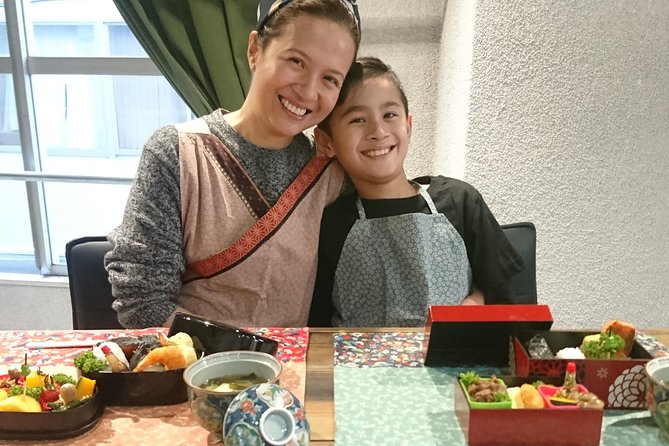
The maximum group size is eight people. That is small enough for the instructor to watch your work and step in when you need help.
This matters most during the rice-ball shaping and bento packing. Those tasks depend on appearance, and a quick correction can make a big difference. A small group also makes it easier for everyone to participate in each dish instead of standing behind one person who does all the cooking.
The class has earned a 5 out of 5 rating from 35 reviews, with 100 percent recommending it. The strongest themes are clear instruction, a clean and professional setting, punctual organization, and a friendly teaching style.
The guide’s English has been described as warm and direct. That is useful in a cooking class, where long explanations can slow the work. You want enough detail to understand the technique, but you also need to know what to do with your hands.
On some dates, the group may be smaller than eight. That can mean more detailed instruction, though group size is not guaranteed.
Is $92.24 a fair price?
At $92.24 per person, this is not the cheapest lunch activity in Osaka. You are paying for more than the food itself, though. The price includes about two and a half hours of instruction, a hands-on menu of up to seven dishes, the ingredients, your bento lunch, and miso soup.
The value is strongest if you want to learn techniques you can repeat. Dashi, marinating, simmering, grilling, frying, rice-ball shaping, and food arrangement give you a broader lesson than a class focused on one dish.
It is also good value for families and food-focused visitors who would otherwise spend part of the day eating without learning how the meal was made. The small group adds to the price, but it also improves access to the instructor.
The value is weaker if you only want a quick meal or a short demonstration. You will spend much of the session preparing food, and you may prefer a restaurant if your schedule is tight. Since the class is usually booked about 53 days ahead, plan early if it fits your Osaka itinerary.
Who will enjoy this Osaka cooking class?
I would recommend it to anyone who enjoys practical activities and wants more connection to Japanese food than a restaurant meal can provide. It suits first-time cooks because the instruction is structured and the rice molds make the onigiri manageable.
It is also a strong choice for families with children old enough to follow kitchen instructions. An adult must accompany each child, and the class format lets younger participants take part in visible tasks rather than simply watch.
Couples, siblings, and friends can enjoy the shared work. One pair even found the omelette technique useful enough to consider buying a frying pan afterward. That is a sign of the class’s practical appeal, though you should not treat it as a shopping recommendation or expect equipment to be included.
Food-focused visitors will appreciate the cultural explanation of dashi and the attention given to bento presentation. People with dietary restrictions should contact the provider at booking, since specific requirements need to be advised in advance.
Timing, meeting point, and booking details
The activity lasts approximately two hours and 30 minutes. It begins and ends at Banix Kitahorie, Japan, 550-0014 Osaka, Nishi Ward, Kitahorie, 3-chome 6-2, Systema Gallery.
The meeting point is near public transportation. Check the exact route and allow enough time to arrive, since punctuality matters when several dishes must be prepared in sequence.
A mobile ticket is available. Booking confirmation is sent within 48 hours, subject to availability. The class is often reserved well ahead, with an average booking time of 53 days, so last-minute planning may not work as well here.
You can cancel for a full refund up to 24 hours before the local start time. Cancellations or changes made less than 24 hours in advance are not accepted for a refund.
Should you book the Sakura Cook bento class?
Book it if you want a hands-on introduction to Japanese home cooking, especially if you value learning several techniques in one session. The combination of dashi, seven dishes, rice-ball shaping, bento packing, and miso soup gives you a well-rounded activity in a manageable half day.
I would be cautious if you want a relaxed meal with little preparation, or if your Osaka schedule cannot spare 150 minutes. The price also makes more sense when you value instruction and participation, not just the amount of food.
For families, first-time cooks, and visitors who want to understand the care behind a Japanese lunch box, this is a strong choice. Choose an early date, share dietary needs when booking, and arrive ready to cook rather than simply eat.
FAQ
Where does the bento cooking class take place?
The class takes place at Banix Kitahorie, Japan, 550-0014 Osaka, Nishi Ward, Kitahorie, 3-chome 6-2, Systema Gallery.
How long does the activity last?
The cooking class lasts approximately two hours and 30 minutes.
What food do you prepare?
You prepare up to seven Japanese home-style dishes using Wagyu beef, shrimp, salmon, egg, squash, mushrooms, green vegetables, and rice. You also make dashi and two triangular rice balls.
Do I get to eat the food I make?
Yes. At the end of the class, you pack the dishes into a bento box and eat your creations with chopsticks and complimentary miso soup.
Is miso soup included?
Yes. Complimentary miso soup is served with the bento meal at the end.
How many people can join the class?
The activity has a maximum of eight travelers.
Can children participate?
Yes, but children must be accompanied by an adult.
Should I share dietary requirements before booking?
Yes. You should advise the provider of any specific dietary requirements at the time of booking.
What is the cancellation policy?
You can cancel up to 24 hours before the local start time for a full refund. Cancellations or changes made less than 24 hours before the start time are not accepted for a refund.
Just added around Osaka
- Nara Day Trip from Osaka with a Licensed Guide★ 5.0 · 3 reviews
- Osaka Early Morning Osaka Castle Tour Avoid Crowds★ 5.0 · 3 reviews
- Guided Tour of Some Attractions in Osaka by Private Car★ 5.0 · 3 reviews
- Private Transfer Between Kyoto and Kansai Airport KIX★ 5.0 · 3 reviews
- Shared Arrival Transfer: Osaka Itami Airport to Osaka City★ 5.0 · 3 reviews
- Osaka: Sushi Making Class and Dotonbori Food Tour★ 4.7 · 3 reviews
- Osaka Night Photography Workshop★ 5.0 · 3 reviews
- Kyoto Full day Tour Kinkakuji, Kiyomizu-dera and Fushimi Inari★ 4.5 · 3 reviews
Osaka Cooking Classes, compared.


Sumo Stage Show with Bento or Snack + Fight & Photo
Read our review →
Traditional Mochi Pounding Experience with Tasting
Read our review →
Osaka Cooking Class: Okonomiyaki &Japanese cuisines experience
Read our review →


Osaka Sake Tasting & Takoyaki Cooking Experience
Read our review →
Cooking Ramen&Gyoza/KatsuCurry/Bento/Okonomiyaki+Store Tour@Osaka
Read our review →Browse the lists this tour appears in