
Reviewed · NARA DAY TRIPS FROM OSAKA
Osaka and Nara Attractive One Day private Tour
Osaka and Nara make an excellent two-part day: modern city energy in Osaka, followed by ancient temples and free-roaming deer in Nara. In about 10 hours, you move from neon signs and high-rise views to a giant bronze Buddha and one of Japan’s oldest temple grounds.
I like the private vehicle for up to five people, especially for families or small groups. I also like the chance to adjust the day, with guides such as Ben, Malik, and Talha praised for being helpful and accommodating. The main catch is time: two hours are set aside for travel between stops, so this is a highlights tour, not a slow look at every site.
In This Review
- Key points to know before booking
- One day, two very different Japans
- Osaka Castle and the story of unification
- Shitennoji, an early Buddhist landmark
- Dotonbori for food, signs, and city life
- Umeda Sky Building and the Osaka view
- Todai-ji and the Great Buddha
- Nara Park and its free-roaming deer
- How the private transport changes the day
- Guide service and what to clarify
- Who will get the best value
- Should you book the Osaka and Nara day?
- FAQ
- How long does the Osaka and Nara private tour last?
- How many people can join the private tour?
- Where does the tour start and end?
- Are admission fees included?
- Is transportation included?
- Can the itinerary be customized?
- What is the cancellation policy?
Key points to know before booking
- Osaka Castle and Todai-ji are optional paid stops: Admission is paid directly on arrival, not included in the tour price.
- Dotonbori gives you two hours: Use it for Osaka food, canal views, neon signs, and a proper city break.
- Nara Park is built for easy wandering: The deer and temple setting offer a very different mood from Osaka.
- The $550 price is per group: Five people bring the cost to about $110 each, while one or two people pay much more per person.
- This may be transport with local help rather than a fully guided tour: One account praised the driver-guide service, while another found that the vehicle mainly delivered passengers to each site.
- The day begins and ends at Osaka Station: Pickup is offered, and the same meeting point is used at the end.
One day, two very different Japans
This tour works because Osaka and Nara complement each other. Osaka gives you castles, shopping districts, food, and modern architecture. Nara supplies temple halls, sacred deer, and a quieter sense of Japan’s early Buddhist past.
You travel in a private, air-conditioned vehicle with tolls, taxes, child seats, and onboard hotspot service included. That matters in a long day. You can leave bags in the vehicle, avoid changing trains with children, and keep the schedule in your own hands.
The tour costs $550 per group of up to five. At full capacity, that is about $110 per person, a fairer deal for a family or group of friends. For a couple, the per-person cost is high compared with public transportation, but you are paying for privacy, direct transfers, and less time figuring out stations and connections.
The description allows customization, which is useful because the schedule is tight. The listed stops total eight hours, leaving roughly two hours for travel. That means you need to make choices. If Osaka Castle takes longer than planned, you may have less time at Dotonbori or Nara Park.
One important point: the service can feel different depending on your expectations. Some guides act as driver-guides and offer recommendations. Another account described the experience as transportation between sites, with drop-off and pickup at agreed times rather than a continuous guided walk. If you want detailed commentary inside every temple, confirm that before booking.
More day trips over to Nara:
- Ancient Capital Tour: Kyoto and Nara Highlights from Kyoto/Osaka
★ 4.5 · 332 reviews - Kyoto and Nara Day Trip from Osaka
★ 4.0 · 175 reviews - Discover Himeji, Kobe and Nara from Osaka
★ 5.0 · 101 reviews
Osaka Castle and the story of unification
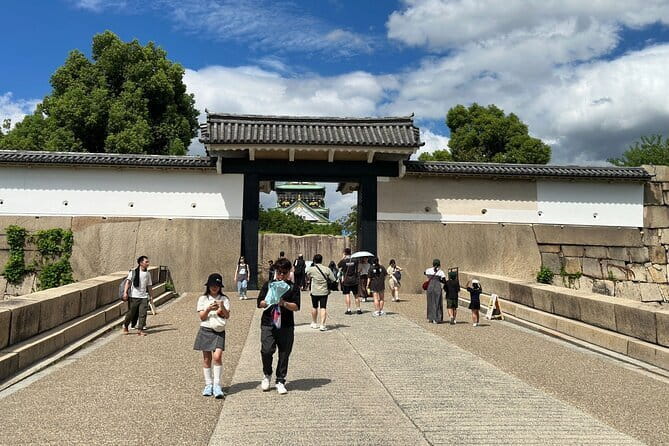
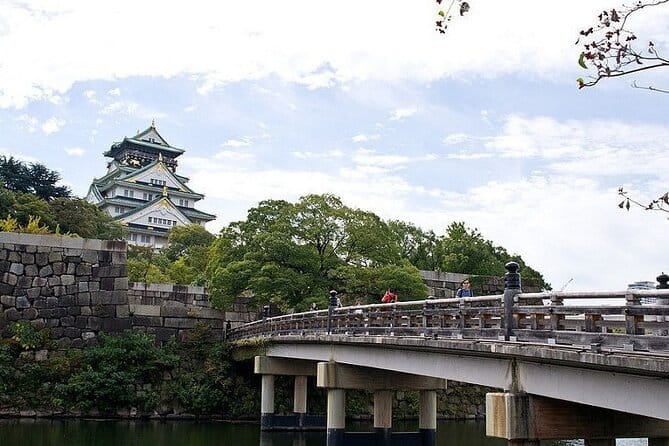
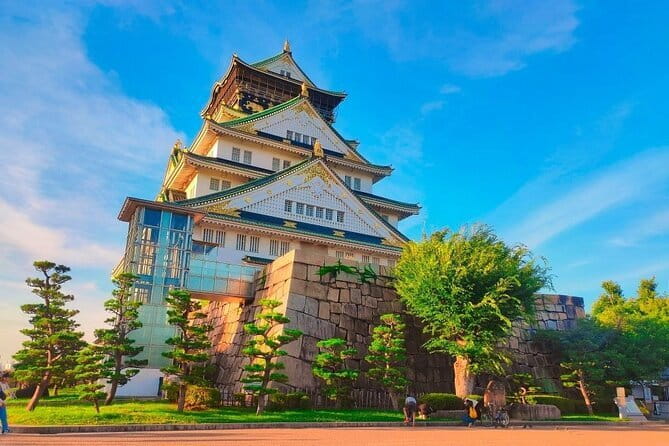
The first stop is Osaka Castle, one of the city’s best-known sights. Toyotomi Hideyoshi built the original castle in the late 16th century as a symbol of Japan’s unification after years of civil war.
The castle also played a major role in the Battle of Osaka in 1614 and 1615. That conflict ended the Toyotomi family’s rule and helped secure the Tokugawa shogunate. Even if you are not a military-history fan, the castle gives useful context for understanding Japan’s transition into a more unified country.
The present building is a reconstruction completed in 1931. The original was destroyed more than once, so you should think of this as a modern recreation of a historic symbol rather than an untouched medieval structure.
You have about one hour here, and admission is not included. The stated fee is about $5. If you want to enter, budget for that small extra charge and keep an eye on the clock. If you prefer photographs, gardens, and the exterior, the stop can work without spending much time inside.
I would use this visit to see the castle from outside first, then decide how much the interior matters to you. With five more stops ahead, you do not want one attraction to consume the day.
Shitennoji, an early Buddhist landmark
Shitennoji gives the Osaka portion of the day a more religious and historic tone. Founded in 593 by Prince Shōtoku, it is regarded as Japan’s first officially established Buddhist temple.
The temple honors the Four Heavenly Kings, protectors believed to guard the world from evil. Its central compound follows an old symmetrical layout, with a five-story pagoda as a key feature. Fires and natural disasters led to repeated rebuilding, but the basic arrangement has been preserved.
Admission is free, which makes this an easy stop in a relatively expensive private day. You have about one hour to see the grounds and take in the architecture.
I like the contrast here. Osaka is often sold through food and bright signs, but Shitennoji shows the city’s older spiritual side without requiring a separate trip far from the center. Still, one hour is not enough for a slow religious-site visit. If you want time for quiet reflection, photography, or a closer look at the buildings, ask how the schedule can be adjusted.
Dotonbori for food, signs, and city life
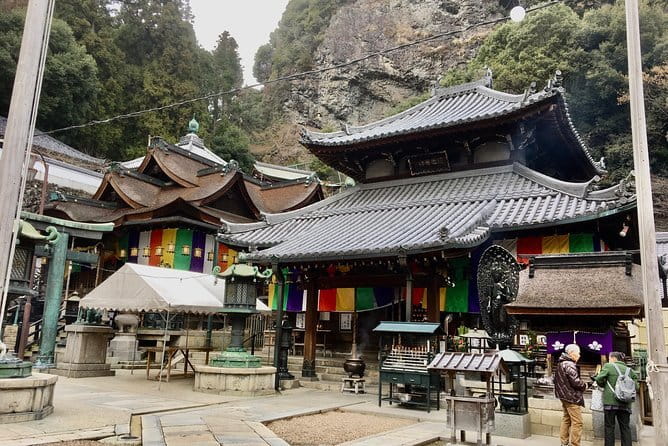
Dotonbori is the tour’s best chance to stop thinking about monuments and simply enjoy Osaka. The district follows the Dotonbori Canal and is famous for its large illuminated signs, including the Glico Running Man.
You have two hours here, the longest single stop in Osaka. That is just enough time to walk beside the canal, take photographs, browse food options, and sit down for a meal if you keep moving.
This is where Osaka’s food identity comes alive. Look for takoyaki, savory pancakes, kushikatsu, ramen, and other local dishes. The area offers both casual stalls and restaurants, so you can keep spending modest or turn the stop into a full meal.
I would save your appetite for Dotonbori. It is also a useful break after the first two historic stops. The tradeoff is that this area can be crowded and commercial, with plenty of bright advertising competing for your attention. That is part of its character, but it is not the place for peaceful old Osaka.
If your group includes children, this stop offers easy choices. If you have dietary restrictions, ask your guide for help before ordering, since no specific restaurant arrangements are included.
A few more Osaka tours and experiences worth a look
- Hiroshima & Miyajima 1 Day Bus Tour with Bullet Train Tickets
★ 4.5 · 105 reviews - From Osaka: Hiroshima and Miyajima Day Trip by Bullet Train
★ 4.6 · 83 reviews - Amanohashidate & Ine Funaya Sightseeing Full Day Trip from Kyoto
★ 4.5 · 62 reviews - Kyoto 1 Day Tour from Osaka
★ 4.0 · 54 reviews
Umeda Sky Building and the Osaka view
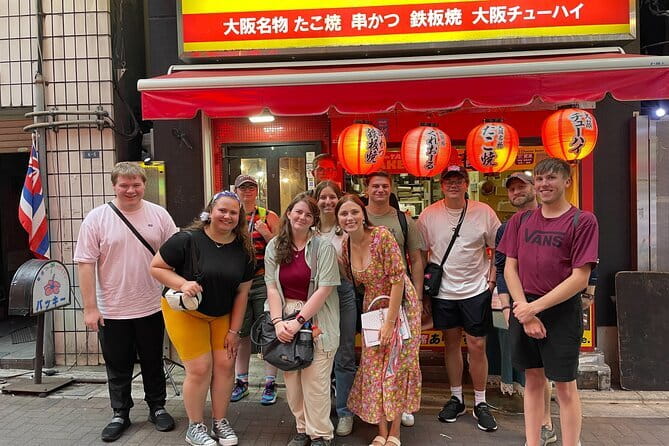
The Umeda Sky Building offers a sharp change of scale. Completed in 1993, it rises 173 meters and joins two 40-story towers at the top with a floating garden observatory.
The upper viewing area provides a 360-degree view of Osaka. The glass-covered escalators connecting the towers are part of the attraction, giving you an unusual sense of moving through open space as you rise.
You get about one hour here. Admission is extra, listed at roughly $10, and paid directly at the site. That cost is reasonable for a major city viewpoint, but it is another add-on to include in your budget.
The best reason to visit is the contrast with Osaka Castle. The castle represents an older political Japan, while Umeda shows the city as a modern commercial center. If views and architecture interest you, this is one of the stronger stops.
The question is timing. If the sky is cloudy or visibility is poor, the observatory may not feel worth the extra admission. Since the day is customizable, you can ask whether it makes more sense to keep the stop short or give that time to Nara.
Todai-ji and the Great Buddha
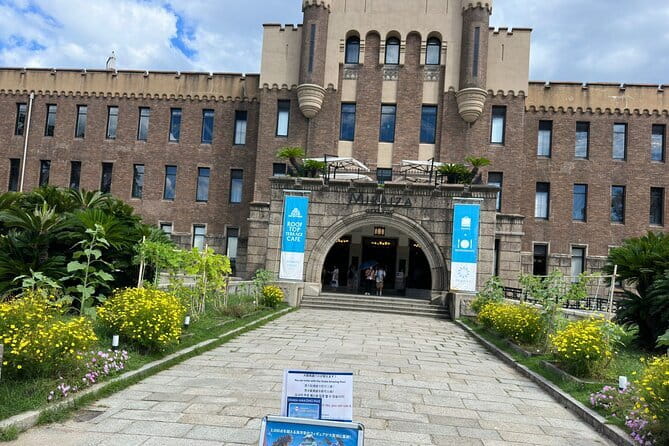
After Osaka, the tour shifts to Nara and its most famous temple. Todai-ji is known for the Great Buddha Hall and its enormous bronze Vairocana Buddha.
The statue is about 15 meters tall and weighs roughly 500 tons. Emperor Shōmu commissioned it in the eighth century to strengthen Buddhism’s role in uniting the country. The Great Buddha Hall was once the largest wooden building in the world and remains one of the largest.
You have two hours at Todai-ji, which is helpful. This is not a quick roadside photo stop. The scale of the hall needs time to register, and the temple grounds provide more to see than the main statue alone.
Admission is not included and is listed at about $2. That is a small extra charge for one of Nara’s central sights, but remember that the castle and Umeda Sky Building also have separate fees.
The temple can be a powerful visit even if you do not know much about Buddhist art. The hall’s size, the Buddha’s scale, and the long history of the site do much of the explaining for you. Your guide may add context, but the amount of commentary can vary, so prepare to explore some of the site independently.
Todai-ji is also where the schedule can get tight. You could easily spend the full two hours here, especially if you stop for photographs or take time with the surrounding buildings. Keep enough time for Nara Park, which is directly part of the experience.
Nara Park and its free-roaming deer
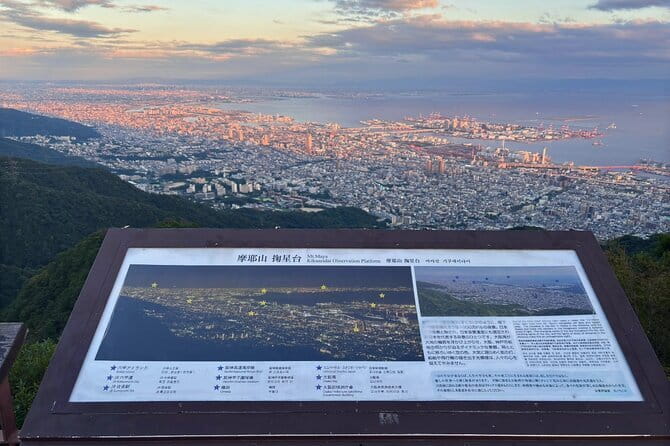
Nara Park is the most relaxed stop of the day. Established in 1880, the park covers more than 500 hectares and connects several important sites, including Todai-ji, Kofuku-ji, and Kasuga Taisha Shrine.
Its best-known residents are more than 1,000 free-roaming deer. In Shinto belief, they are sacred messengers of the gods. You can buy special deer crackers, called shika senbei, and feed them.
The deer are accustomed to people and may bow when asking for food. That makes for a memorable family experience, but use common sense. Feed them only the proper crackers, keep paper and loose food away, and remember that the animals are still animals. The information provided describes them as tame, not as pets.
You have about one hour in the park. That is enough to see deer, walk a little, and enjoy the setting near Todai-ji. It is not enough to cover every temple and shrine in the wider park area.
I would treat Nara Park as the day’s breathing space. Osaka asks you to look up at signs and towers. Nara asks you to slow down and notice what is around your feet. If deer are your main reason for visiting Nara, use this hour well and do not let shopping or a long temple visit take all of it.
How the private transport changes the day
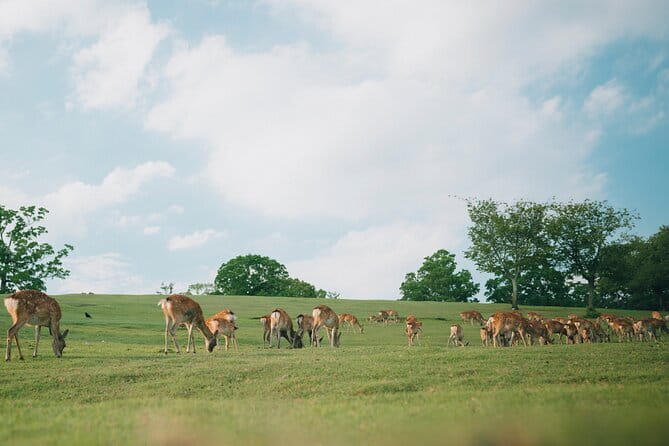
The private vehicle is the main practical advantage. The tour can provide different vehicle sizes according to group numbers, and child seats are included. That makes the arrangement useful for families, older relatives, or anyone who does not want a long day of train transfers.
You start at Osaka Station, at 3-chōme-1-1 Umeda in Kita Ward, and return there when the activity ends. Pickup is offered, but confirm the exact meeting arrangement before the day begins.
A mobile ticket makes access simple. Confirmation is provided at booking, and service animals are allowed. The tour is near public transportation, though the point of paying for it is to avoid relying on public transportation throughout the day.
The onboard hotspot is a nice extra for checking maps, translating signs, or keeping children occupied. Tolls and taxes are included, so you do not need to manage those costs during the trip.
The biggest limitation is the fixed 10-hour window. The operator notes that about two hours are used for travel from one place to another. That leaves little room for traffic, long meals, or spontaneous detours. Customization helps, but it does not create extra hours.
Guide service and what to clarify
The strongest accounts name Ben, Malik, and Talha. Ben was described as accommodating to requests, while Malik helped with the route through Nara Park, Todai-ji, Osaka Castle, and the Umeda shopping area. Talha was praised for taking a group to all the destinations and offering recommendations.
Those details suggest that the quality of the day can depend heavily on the individual driver-guide. I would ask three questions before booking:
- Will the driver walk with you at each site?
- How much historical explanation is included?
- Can the order or length of stops be changed during the day?
That last question matters because Osaka and Nara offer more than the schedule can hold. You may prefer a longer Dotonbori meal, extra time at Todai-ji, or a shorter stop at Umeda Sky Building.
There was also a serious service failure reported in one case, when a driver became ill and the tour was canceled on the day. The operator said it tried to find a replacement, offered to move the booking, and issued a refund. This appears to be an isolated problem rather than a normal feature, but same-day cancellations are worth keeping in mind when planning a tightly scheduled vacation day.
Free cancellation is available up to 24 hours before the start time for a full refund. Changes or cancellations inside that window are not accepted for a refund.
Who will get the best value
I would recommend this day most strongly to families and small groups of up to five. The vehicle, child seats, direct transfers, and private schedule can justify the cost when several people share it.
It also suits first-time visitors who want a broad introduction to Osaka and Nara without handling every route themselves. You see a castle, old temple, food district, modern observation building, giant Buddha, and deer park in one day.
Couples should compare the price carefully. At $550 for two people, the cost is high, even with the convenience of private transport. A couple that values flexibility and door-to-door travel may still find it worthwhile, but the value improves sharply with four or five people.
I would not choose this if your priority is a slow, detailed temple study or a fully guided cultural lecture. The schedule is built around seeing many major places, and at least one account understood the service mainly as transportation with pickup times.
Should you book the Osaka and Nara day?
Book it if you want maximum coverage with minimum transport planning, especially with a family or group. The combination of Dotonbori, Osaka Castle, Umeda Sky Building, Todai-ji, and Nara Park gives you a memorable first look at two very different sides of Japan.
Before paying, confirm the guide’s role and agree on your priorities. Ask whether you can shorten or skip one stop to protect time at another. Budget separately for the approximately $5 Osaka Castle admission, $10 Umeda Sky admission, and $2 Todai-ji admission.
My call: this is a useful private highlights day, not a slow cultural tour. Choose it for convenience, range, and the freedom to travel together. Skip it if your group is small and comfortable with trains, or if you want every stop explained in depth.
FAQ
How long does the Osaka and Nara private tour last?
The tour lasts approximately 10 hours. About two hours are allocated to travel between locations, leaving roughly eight hours for sightseeing stops.
How many people can join the private tour?
The price covers one private group of up to five people. Only your group participates in the activity.
Where does the tour start and end?
The meeting point is Osaka Station, at 3-chōme-1-1 Umeda, Kita Ward, Osaka. The activity ends back at the same meeting point.
Are admission fees included?
No. Osaka Castle, Umeda Sky Building, and Todai-ji are optional paid stops, with admission paid directly on arrival. The stated fees are about $5 for Osaka Castle, $10 for Umeda Sky Building, and $2 for Todai-ji. Shitennoji and Nara Park are listed as free.
Is transportation included?
Yes. The tour includes private transportation in an air-conditioned vehicle, tolls, taxes, child seats, and a hotspot onboard. Vehicle types can be arranged according to group size.
Can the itinerary be customized?
Yes. The tour allows customization according to your wishes. Because the day lasts about 10 hours, ask in advance how changing the length or order of stops will affect the schedule.
What is the cancellation policy?
You can cancel at least 24 hours before the start time for a full refund. Cancellations or changes made less than 24 hours before the experience are not accepted for a refund.
Just added around Osaka
- Nara Day Trip from Osaka with a Licensed Guide★ 5.0 · 3 reviews
- Osaka Early Morning Osaka Castle Tour Avoid Crowds★ 5.0 · 3 reviews
- Guided Tour of Some Attractions in Osaka by Private Car★ 5.0 · 3 reviews
- Private Transfer Between Kyoto and Kansai Airport KIX★ 5.0 · 3 reviews
- Shared Arrival Transfer: Osaka Itami Airport to Osaka City★ 5.0 · 3 reviews
- Osaka: Sushi Making Class and Dotonbori Food Tour★ 4.7 · 3 reviews
- Osaka Night Photography Workshop★ 5.0 · 3 reviews
- Kyoto Full day Tour Kinkakuji, Kiyomizu-dera and Fushimi Inari★ 4.5 · 3 reviews
Nara Day Trips from Osaka, compared.

Ancient Capital Tour: Kyoto and Nara Highlights from Kyoto/Osaka
Read our review →

Kyoto & Nara Private customized tour with English speaking Guide
Read our review →
Kyoto and Nara UNESCO Highlights Full-day Tour From Osaka
Read our review →
Kyoto & Nara & Uji: Full Day Sightseeing Tour from Osaka or Kyoto
Read our review →Browse the lists this tour appears in