
Reviewed · OSAKA BIKE & CYCLING TOURS
Urban Canvas: Osaka Street Art Bike Tour
Osaka’s best art may not be in a museum. It is painted on walls, tucked beneath train lines, and scattered through working neighborhoods that most visitors skip. This four-and-a-half-hour bike ride takes you through Tenma, Juso, and Nakazaki-cho, with a local guide explaining the city’s street art and its less polished side.
I like the small group, limited to six people, and the route’s mix of art, urban views, food, and local life. I also like that guides such as Ruben and Eric can discuss both the artwork and everyday Osaka, rather than simply pointing at walls. The main consideration is the distance: around 23 kilometers by bike, with limited appeal for anyone who dislikes sustained cycling.
In This Review
- Key points
- Why Osaka looks different from a bicycle
- Tenma begins the ride with a local view
- Crossing the Yodo River into Juso
- Juso reveals Osaka’s rougher creative side
- Coffee, a standing bar, and a taste of local rhythm
- Nakazaki-cho trades grit for small shops and galleries
- What the 270-minute pace feels like
- Weather can change the plan
- Is $87 a fair price?
- Who will enjoy this Osaka bike tour?
- Should you book Urban Canvas?
- FAQ
- How long does the Osaka Street Art Bike Tour last?
- How much does the tour cost?
- Where does the tour meet?
- Is hotel pickup included?
- What language is the tour offered in?
- How large is the group?
- Is a bicycle provided?
- Is food included?
- What should I bring?
- What happens if it rains?
Key points
- Ride about 23 km through Tenma, Juso, and Nakazaki-cho, rather than staying in Osaka’s main tourist zones.
- Cross the Yodo River for broad views of bridges, train lines, modern buildings, and Juso’s gritty streets.
- See local and international street art while learning how Osaka’s underground creative scene operates.
- Stop for coffee, a standing-bar experience, and a pizza slice in a 100-year-old building.
- Cycle with no more than six participants, giving you room to ask questions and take photographs.
- Plan for weather and fitness, since the tour may be canceled when rain is more than 60 percent likely.
Why Osaka looks different from a bicycle
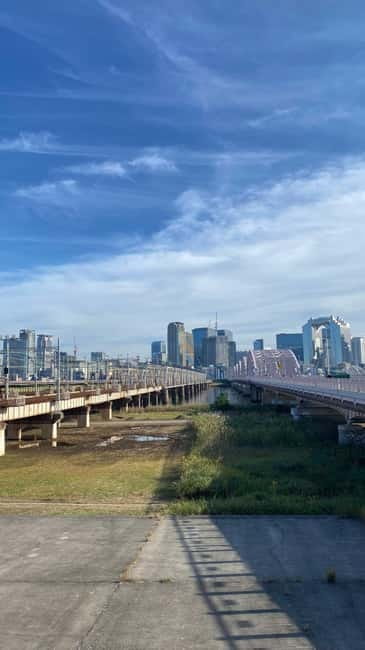
Osaka is often sold through giant signs, food arcades, castle views, and crowded shopping streets. This ride gives you another version of the city: narrow neighborhood roads, concrete walls, bridges, railway corridors, riverside views, graffiti, and modern towers rising behind older buildings.
That change of pace is the point. From a bicycle, you cover more ground than you would on foot, but you still move slowly enough to notice details. You can pause beside a wall, ask about an artist, and take a photograph before riding on.
The route is not built around famous sights. It is built around urban texture. If you want Osaka’s headline attractions, this is the wrong half-day. If you want to see how the city feels away from the main tourist flow, it makes a strong case.
The meeting point is about a 10-minute walk from Tenmabashi Station, served by the Osaka Metro and Keihan Line. There is no hotel pickup, so allow time to find the starting point and arrive ready to ride.
More rides by bike:
- 5-Hour Osaka Bike Tour to the Neighborhood of Osaka Castle
★ 5.0 · 319 reviews - One-Day Osaka Bike Adventure: 5–6 Hours
★ 5.0 · 246 reviews - Eat, Drink & Cycle: Osaka Foodie Bike Tour
★ 5.0 · 224 reviews
Tenma begins the ride with a local view
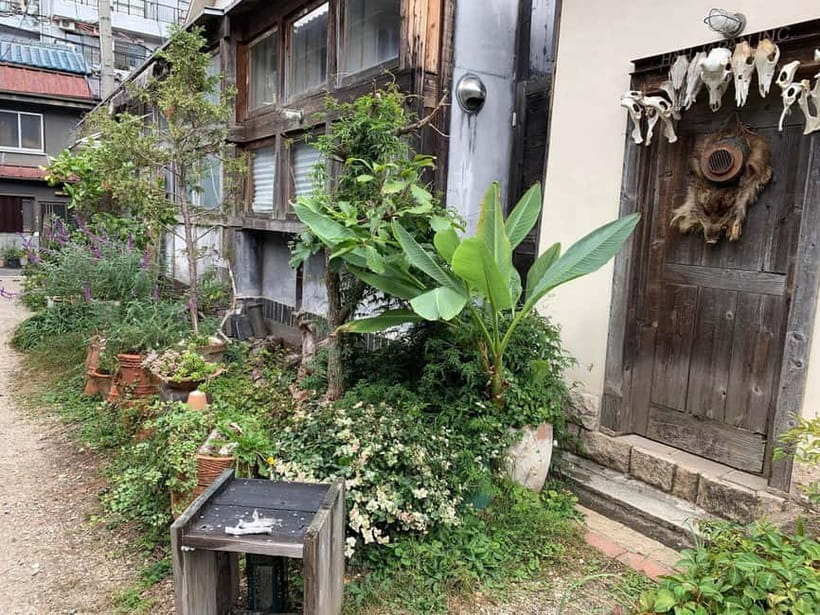
Tenma provides an early taste of Osaka’s everyday city life. The tour uses this area as part of a route through neighborhoods where walls, older buildings, railway lines, and newer development sit close together.
Your English-speaking guide sets the tone here. The guide is not only there to lead the bicycles. You can ask about the artists, Osaka, Japan, and the city’s underground life. Ruben has been praised for taking time with questions, while Eric brings a clear passion for the artwork and the displays.
That matters because street art can be easy to misread. A painted wall may look like a quick photo stop if you do not know the background. A guide can point out patterns, explain the local scene, and help you notice work by both Japanese and international artists.
The group size helps. With a maximum of six people, the ride should feel more like a small outing than a moving crowd. You still need to stay alert around traffic and follow the guide’s pace, but a small group makes it easier to stop for photographs and conversation.
Crossing the Yodo River into Juso
One of the route’s strongest moments comes when you cross the Yodo River toward Juso. The bridge provides a change in scale. Instead of looking at one wall or side street, you get open views of the river, bridges, rail lines, and Osaka’s modern skyline.
The crossing also gives the tour a useful sense of place. Juso is only a bridge away from the central city, yet it feels far less polished and far less arranged for sightseeing. Its streets carry a rougher, more local character, and that contrast is part of what makes the route worthwhile.
You should not expect a grand viewpoint with a long stop and formal commentary. The appeal is in seeing the city from the saddle, then moving into Juso to explore its streets. The bridge is a link between two types of Osaka: the central urban core and a neighborhood where local businesses and street art share the same tight spaces.
Bring a camera, but keep it easy to reach. You will want to photograph murals, details on building walls, trains, bridges, and the changing views as you ride.
Juso reveals Osaka’s rougher creative side
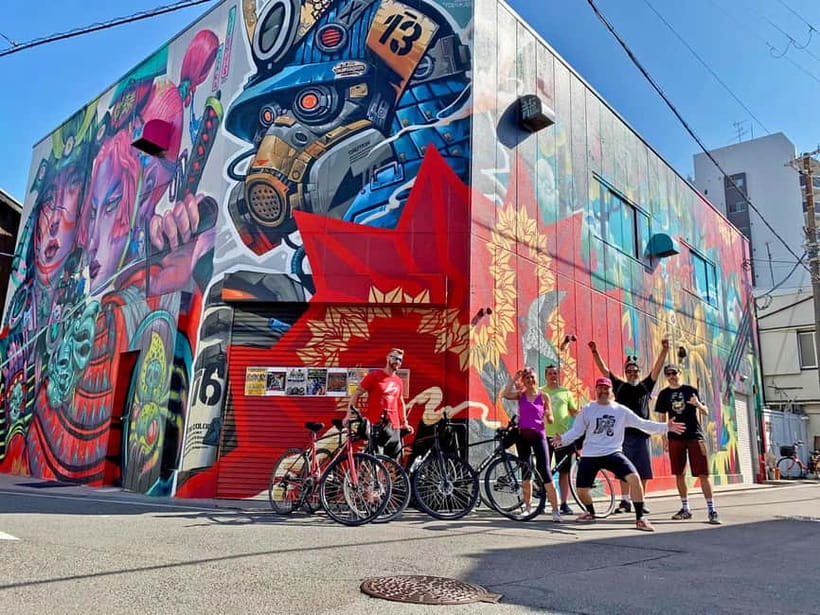
Juso is described as one of the centers of Osaka’s street art scene, and the tour spends time in the middle of the neighborhood rather than skimming its edge. This is where the ride feels most different from a standard city sightseeing route.
You may see art beside ordinary shops, along rough walls, near railway lines, or in spaces shaped by the city’s working life. The setting matters as much as the paintings. Street art here is not separated from the neighborhood by gallery doors or ticket counters. It shares space with daily Osaka.
The guide’s commentary adds context about the city’s underground life. That phrase does not mean a literal underground attraction. It points to the creative, informal, and less visible side of Osaka, the part you are unlikely to understand from a shopping district or a major landmark.
I like this section because it asks you to look beyond the artwork itself. You see how artists use leftover urban spaces, how different styles appear side by side, and how local character changes from one district to the next.
There is also a practical tradeoff. Street art changes. Walls can be painted over, altered, or removed, and no precise artwork list is provided. If one particular mural is your reason for booking, you should treat the route as a broad street art experience rather than a guaranteed checklist.
A completely different way to spend a day in Osaka:
- Osaka Go Karting Tour with Funny Costume
★ 5.0 · 2,658 reviews - Osaka Castle: Museum and Tower Entry Ticket
★ 4.5 · 2,380 reviews - Osaka: Shinsekai Food Tour with 13-15 Dishes at 5 Eateries
★ 4.8 · 2,204 reviews - Osaka Food Tour: 13 Dishes at 5 Local Eateries
★ 5.0 · 2,149 reviews
Coffee, a standing bar, and a taste of local rhythm
The food and drink stops give the ride a welcome human scale. Along the way, you have time for specialty coffee and a stop at an old-school standing bar. These are small breaks, but they help divide a long cycling route into manageable sections.
A standing bar is not the same as sitting down for a long restaurant meal. It offers a quick look at a familiar local format and keeps the tour moving. If you want a full introduction to Osaka food, this is not that. If you enjoy seeing how people use neighborhood businesses, the stop adds something that a mural-only route would miss.
The exact timing of the breaks can vary, and you should not count on every stop being a lengthy rest. Still, the pauses are useful after several kilometers. They give you space to ask the guide about the art, check your camera, and reset before the next section.
Water is included. Comfortable clothing and shoes are important, not just for style but because the ride lasts 270 minutes. You do not need to dress for a formal attraction. Wear clothes that let you pedal, stop, and move around comfortably.
Nakazaki-cho trades grit for small shops and galleries
Later, the route moves into Nakazaki-cho, a more fashionable neighborhood with boutique shops and galleries. The mood shifts again. After Juso’s rougher streets and industrial urban views, Nakazaki-cho offers a more polished creative setting.
This contrast gives the tour shape. You are not seeing one uniform version of Osaka’s art scene. You move from public walls and gritty infrastructure to small businesses, independent spaces, and older buildings adapted for newer uses.
The area’s most distinctive food stop is a local institution serving pizza slices in a 100-year-old building. A single slice is included, so this is a snack rather than a full meal. It is a memorable detail because the food, building, and neighborhood all tell part of the same story: old Osaka spaces continuing to support newer city culture.
If you have dietary restrictions, provide that information when booking. The tour specifically asks for this detail, and it is better to clarify before the ride than at the food stop.
Nakazaki-cho is also a good place to slow down and notice the small scale of the city. Boutique shops and galleries can be easy to miss when you are focused on major sights. Here, the bicycle makes it possible to connect several pockets of the neighborhood without turning the afternoon into a long walk.
What the 270-minute pace feels like
Four and a half hours is a substantial block of your Osaka schedule. The route covers a lot, and one account of the ride put the distance at about 23 kilometers. That is not a casual spin around one park.
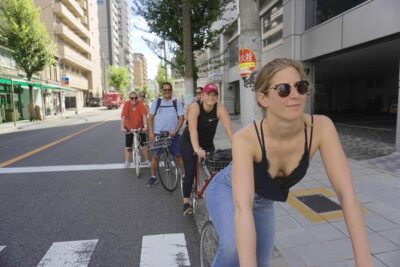
The cycling pace has been described as safe and manageable, with enough time to photograph the artwork. Still, you should be comfortable riding for several hours with repeated stops and starts. The route includes city streets, bridges, and neighborhood roads, so this is not a protected cycle path experience from beginning to end.
The bicycle, helmet, water, and guide are included. You do not need to arrange equipment separately, but you should provide the height of everyone in your group so the bikes can be prepared properly.
Children under 10 are not suitable for the tour, and children under 13 are not recommended. The activity is also not suitable for wheelchair users or people with mobility impairments. That is worth taking seriously: the route’s appeal depends on being able to pedal, balance, stop, and get on and off a bicycle.
The tour is offered in English. A small group and a live guide are valuable here because much of the experience depends on explanation. Without commentary, you would still see walls and streets, but you would miss much of the social and artistic context.
Weather can change the plan
Osaka’s weather matters for this activity more than it would for a museum visit. If the chance of rain is higher than 60 percent during the tour, the operator cancels and offers a different date or a full refund.
Make sure you can be reached on the day. This is especially important if your Osaka schedule is tight or you are leaving the city soon after the tour.
You can cancel up to 24 hours in advance for a full refund, and the reserve-now-pay-later option lets you hold a place without paying immediately. Those policies make planning easier, but they do not remove the need for a weather backup. Keep a museum, food tour, or shopping district in mind in case the bicycles stay parked.
Is $87 a fair price?
At $87 per person, this is not the cheapest way to spend a half-day in Osaka. You could rent a bicycle for less, ride through a neighborhood, and find your own coffee and pizza. The price here pays for something different: a prepared route, equipment, an English-speaking local guide, a small group, the included water and pizza, and the explanations that connect the art to the city.
The value is strongest if you care about street art and want access to areas you might not choose on your own. It is also useful if you prefer a planned route that links Tenma, Juso, and Nakazaki-cho without working out the bridges, streets, and stops yourself.
The value is weaker if you mainly want famous Osaka sights, a full meal, or a relaxed outing with very little physical effort. The pizza is one slice, and the coffee and bar stops are short breaks rather than a food-focused itinerary.
I would compare it with the cost of other small-group guided activities in Osaka, but the more useful question is simpler: will you use the guide’s local knowledge? If yes, the price is reasonable for nearly four and a half hours with equipment and food included. If you only want to ride a bike, save your money and rent one independently.
Who will enjoy this Osaka bike tour?
I would choose this outing if you have already seen some of central Osaka and want a different angle. It suits visitors who like photography, public art, architecture, railways, rivers, neighborhood food, and stories about the city beyond its headline attractions.
It also works well for repeat visitors. The route reaches places you may not place on a first-time Osaka checklist, especially Juso. The small group makes it a good fit for people who want to ask questions instead of listening to a guide speak to a large crowd.
You should think twice if you dislike bicycles, have mobility limits, or want a slow food experience. The tour covers a serious distance, and the urban setting means you must remain aware of streets, bridges, and other road users.
One small improvement would be a printed or digital record of the artworks and the guide’s key points. After several hours, it can be hard to remember every artist and story. Take your own notes or photographs with brief captions if you want to keep the art details after the ride.
Should you book Urban Canvas?
Book it if you want to see a less familiar Osaka, enjoy cycling, and value a guide who can explain both street art and local life. The strongest parts are the small group, the ride across the Yodo River, the time in Juso, and the mix of art with coffee, a standing bar, and pizza in an old building.
Skip it if you need a short, gentle activity or if your main goal is Osaka Castle, Dotonbori, or other major sights. For the right rider, $87 buys more than a bicycle trip. It buys a carefully connected view of Osaka’s walls, bridges, neighborhoods, and creative life.
FAQ
How long does the Osaka Street Art Bike Tour last?
The tour lasts 270 minutes, or four and a half hours.
How much does the tour cost?
The price is $87 per person.
Where does the tour meet?
The meeting point is about a 10-minute walk from Tenmabashi Station, served by the Osaka Metro and Keihan Line.
Is hotel pickup included?
No. Hotel pickup and drop-off are not included.
What language is the tour offered in?
The live tour guide speaks English.
How large is the group?
The tour is limited to six participants.
Is a bicycle provided?
Yes. A bicycle and helmet are included.
Is food included?
Yes. A pizza slice and water are included. The route also includes stops for coffee and an old-school standing bar.
What should I bring?
Bring comfortable shoes, comfortable clothing, and a camera. You should also provide the height of each person in your group and any dietary restrictions.
What happens if it rains?
If the chance of rain is higher than 60 percent during the tour, the operator cancels and offers another date or a full refund. Make sure you can be reached about the change.
Just added around Osaka
- Nara Day Trip from Osaka with a Licensed Guide★ 5.0 · 3 reviews
- Osaka Early Morning Osaka Castle Tour Avoid Crowds★ 5.0 · 3 reviews
- Guided Tour of Some Attractions in Osaka by Private Car★ 5.0 · 3 reviews
- Private Transfer Between Kyoto and Kansai Airport KIX★ 5.0 · 3 reviews
- Shared Arrival Transfer: Osaka Itami Airport to Osaka City★ 5.0 · 3 reviews
- Osaka: Sushi Making Class and Dotonbori Food Tour★ 4.7 · 3 reviews
- Osaka Night Photography Workshop★ 5.0 · 3 reviews
- Kyoto Full day Tour Kinkakuji, Kiyomizu-dera and Fushimi Inari★ 4.5 · 3 reviews
Osaka Bike & Cycling Tours, compared.
5-Hour Osaka Bike Tour to the Neighborhood of Osaka Castle
Read our review →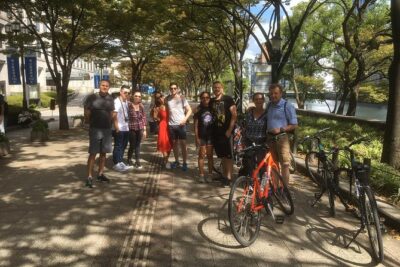
Browse the lists this tour appears in